
In Short
After reading this, you will be able to use physical techniques to reduce nervous fidgeting and project calm, confident presence in any high-stakes conversation or presentation.
- Ground your body before you speak, not during
- Use deliberate hand placement to replace restless movement with stillness
- Practise these techniques in low-stakes settings until they become automatic
Nervous fidgeting techniques are physical methods used to interrupt and replace restless, anxious movement during communication. They work by grounding the body, managing breath, and establishing deliberate stillness so your physical expression supports your message instead of contradicting it.
You know the moment. You are standing in front of a room, or sitting across from someone important, and your hands will not stay still. You tap the pen. You shift your weight. You touch your face twice in thirty seconds. The words coming out of your mouth sound reasonably confident. But your body is telling a completely different story, and everyone in the room can see it.
Nervous fidgeting is one of the most common physical expression problems I have watched people struggle with across sixty years. It is not a personality flaw. It is your body trying to bleed off tension it does not know what else to do with. The real trouble is that most people try to stop fidgeting by thinking harder about stopping, which makes everything worse. The body does not respond to willpower. It responds to practice and physical structure.
In this guide, you will get a clear, practical process for nervous fidgeting techniques that you can use immediately. If you want to understand how physical expression connects to deeper communication habits, The Role of Emotional Intelligence in Team Synergy is worth reading alongside this.
Why Controlling Restless Movement Is Harder Than It Looks
Knowing that your fidgeting is undermining you does not make it stop. I have watched people with decades of public speaking experience still tap their rings against a table when the conversation gets uncomfortable. Awareness alone is not a cure.
Here is why reducing nervous fidgeting is genuinely difficult:
Your body acts faster than your mind. By the time you notice you have been clicking a pen for two minutes, the habit is already running. Fidgeting is a reflex, not a choice, and reflexes require physical retraining, not just mental reminders.
High-stakes moments amplify every nervous habit. The situations where stillness matters most, job interviews, performance reviews, important presentations, are the exact situations where anxiety peaks. Your body's urge to move increases precisely when you most need it to stop.
Suppression creates new tension. When you try to hold your hands rigid to stop fidgeting, you trade visible movement for invisible muscular strain, which often breaks out elsewhere. Clenched jaw, stiff shoulders, or a flat, lifeless voice are all common results.
Fidgeting habits are deeply conditioned. Many of these patterns started in childhood and have been rehearsed thousands of times. You are not correcting a new behaviour. You are replacing one that has years of repetition behind it.
The environment rarely helps. Uncomfortable chairs, bright lights, unfamiliar rooms: these all heighten physical unease and increase the urge to move. You cannot always control the setting.
The goal is not to eliminate these difficulties. It is to build a system that works in spite of them.
"The Conversation You're Avoiding Is the One You Need to Have."
"The Conversation You're Avoiding
Is the One You Need to Have."
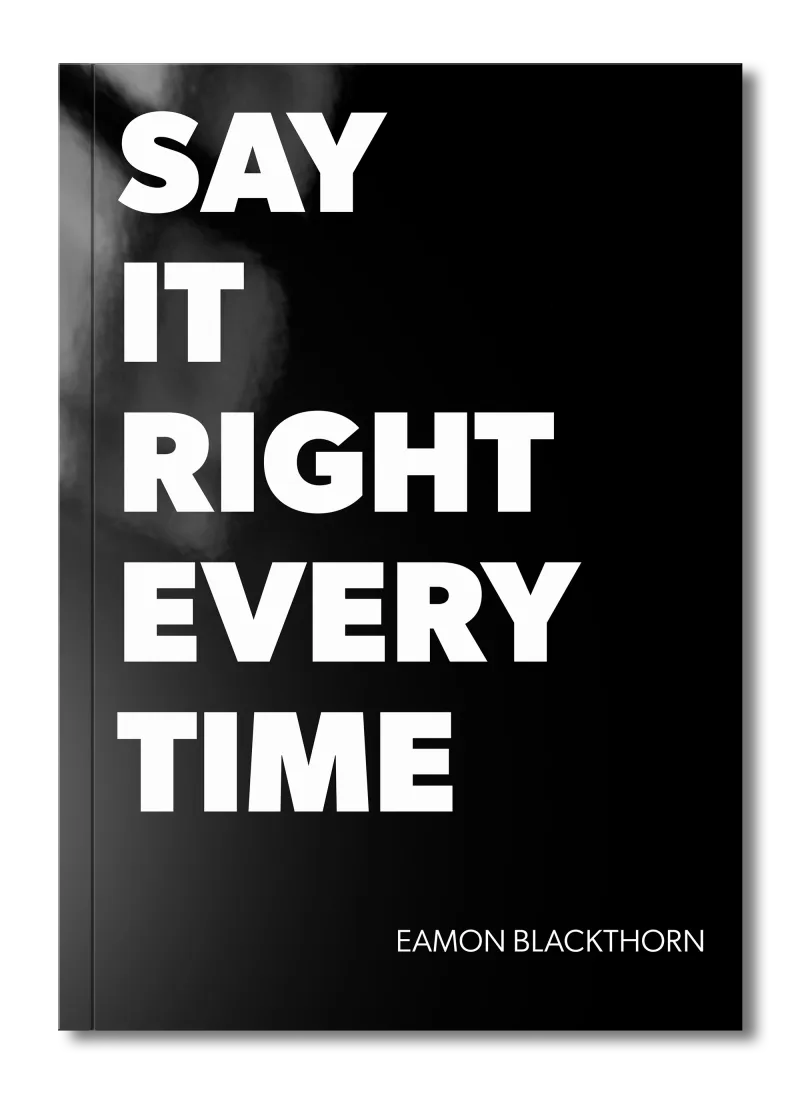
Stop rehearsing conversations you'll never have. Say It Right Every Time gives you 115 word-for-word scripts and 16 proven frameworks to speak with confidence in every conversation that matters.
The Foundation: What You Need Before You Start
Before you begin, there are three things that need to be clear.
Know your specific triggers. Not all fidgeting is the same. Some people tap their feet. Others click pens, pull at clothing, or touch their face repeatedly. Before you can change a physical habit, you need to know exactly what it is. Spend two days watching yourself in everyday conversations and write down what you notice.
Accept that rehearsal is non-negotiable. These are physical skills, the same as any other. You cannot read your way to stillness. You need to practise in your body, in front of a mirror or on camera, before you need these techniques in a real situation. Ten minutes a day is enough. Skipping the rehearsal means the technique will not be available when the pressure is on.
Understand the difference between stillness and stiffness. The goal is relaxed physical composure, not frozen rigidity. A body that is locked and tense communicates fear just as clearly as one that is constantly moving. What you are practising is grounded ease, weight settled, breath steady, hands at rest without being clamped.
Get these right first. The steps that follow will not work without them.
Step 1: Map Your Fidgeting Pattern
Understanding exactly what your body does under pressure is the first step toward changing it.
You cannot replace a habit you have not clearly identified. Most people have a vague sense that they "fidget a lot," but they cannot name the specific movements. That vagueness is why most attempts to stop fail. This step gives you precise information to work with.
- Record yourself in a practice run of a conversation or presentation, even five minutes on your phone.
- Watch the recording with the sound off so your attention stays entirely on your body.
- Write down every specific movement you notice: foot tapping, pen clicking, hair touching, ring turning, weight shifting.
- Rank them by frequency. The most common habit is your starting point.
- Note whether the movement happens at specific moments, pauses, difficult questions, transitions between points.
Here is what this looks like in practice. A project manager named Ciaran watched a recording of himself leading a team briefing. With the sound off, he could see that he touched his collar at least once every forty-five seconds, always when he paused to gather a thought. He had never noticed it before. Once he could see the exact trigger, touching his collar when uncertain, he had something specific to replace, not just a vague instruction to "stop fidgeting."
Mapping your pattern turns a diffuse problem into a solvable one. With your list in hand, you are ready to build a physical replacement.
Step 2: Establish Your Ground Position
Your ground position is a specific physical posture you adopt before and during high-stakes communication that makes stillness the default rather than the exception.
Fidgeting happens most when your body has no clear instruction about where to be. A ground position removes that uncertainty. It gives every part of your body a home. When you drift from it, you notice immediately and return without drama.
- Seat yourself with both feet flat on the floor, hip-width apart, with equal weight on each foot.
- Let your hands rest loosely on your thighs or on the table in front of you, fingers slightly curled, not pressed flat and not clenched.
- Settle your weight into your seat rather than perching on its edge. Feel the chair support you.
- Soften your jaw and your shoulders deliberately. Take one slow breath through the nose to release any tension you are holding.
- Practise holding this position for two full minutes daily, without moving, until it feels natural rather than effortful.
The ground position is your physical home base. Every nervous fidgeting technique that follows builds from this foundation. When you feel the urge to tap or shift, returning to your ground position is always the first move.
Step 3: Replace Movement with Deliberate Gesture
The most effective nervous fidgeting technique is not suppression. It is substitution. You replace involuntary, anxious movement with deliberate, purposeful gesture.
Your hands need something to do. If you deny them all movement, the tension finds another outlet. Instead, give them specific, intentional gestures tied to what you are saying. This channels the physical energy productively rather than fighting it.
- Identify three simple gestures you will use: one for listing points (counting on fingers, folded back after each one), one for emphasising an idea (a single slow downward press of both hands), and one for openness (turning both palms briefly upward).
- Practise each gesture in front of a mirror until it feels natural, not theatrical.
- In your ground position between gestures, return your hands to a neutral rest: loosely curled on your thighs or flat on the table with the thumb alongside the palm.
- Use the "gesture and return" rhythm: make the deliberate gesture, complete it fully, and bring your hands back to rest before your next point.
Here is the difference this makes. Before learning the gesture-and-return method, a department head named Aoife would wave her hands in continuous, agitated loops throughout any difficult conversation. After three weeks of practice, she used deliberate open-palm gestures when making key points and returned her hands to her lap between them. Her colleagues later told her she seemed far more in control. Nothing about her words had changed. Her physical expression had.
Deliberate gesture does not just reduce fidgeting. It actively builds the impression of composure and authority.
Step 4: Use Breath to Interrupt the Fidget Reflex
Slow, controlled breathing is the most direct physical tool you have for interrupting the anxiety response that drives fidgeting.
When your nervous system registers threat, it prepares your body to move. Rapid breathing and muscle tension are part of that preparation. Fidgeting is one result. You can interrupt this cycle at the source by changing your breath pattern before it escalates into visible movement.
- Before any high-stakes conversation or presentation, take three diaphragmatic breaths: inhale slowly through the nose for four counts, hold for two, exhale through the mouth for six.
- During the conversation, if you notice a familiar fidgeting urge building, take one slow breath before you respond to the next question or make your next point.
- Pair your breath with your ground position. As you exhale, consciously settle your weight and soften your shoulders.
- In meetings, you can practise this invisibly. Nobody notices one slow breath. They do notice the hand that will not stop tapping.
- Build a pre-performance breathing habit: do your three-breath reset every time before you enter a room where the stakes feel high.
The breath does not eliminate nerves. It reduces the physical tension that turns nerves into visible restless movement. Used consistently, it becomes the first line of your physical composure system. When anxiety and fidgeting affect how well teams communicate, it is worth understanding what psychological safety enables in honest communication, because the same internal conditions that drive one drive the other.
Step 5: Build a Pre-Performance Physical Ritual
A consistent physical ritual completed before any high-stakes moment primes your body for composure and reduces the likelihood of nervous fidgeting before you even begin.
Sport coaches have known this for generations. A reliable pre-performance routine trains the nervous system to associate specific physical actions with a calm, focused state. Your body learns: when I do these things, I am prepared. The ritual itself becomes a physical trigger for composure.
- Choose a sequence of four to six physical actions you will complete before every high-stakes situation, in the same order each time.
- A useful sequence: stand in a quiet space, plant feet hip-width apart, roll shoulders back and down twice, take three diaphragmatic breaths, set your hands in your neutral rest position, and hold for ten seconds.
- Practise this ritual daily for two weeks in low-stakes settings, before ordinary phone calls, before team check-ins, before any conversation where the pressure is mild.
- When a genuine high-stakes moment arrives, complete the ritual in full, even if you only have thirty seconds.
- After each use, note whether your composure held longer than before. That data builds confidence in the system.
Here is what this looks like before a performance review. The night before, practise the ritual at home. In the morning, do it again. In the corridor outside the meeting room, find thirty seconds to plant your feet, roll your shoulders, take three breaths, and set your hands. By the time you walk through the door, your body has already been told what to do. What is psychological safety and how it drives team synergy explores how personal composure connects to the broader environment you create for others, which is worth considering once your own physical habits are stable.
The ritual does not remove nerves. It gives your body a clear physical pathway through them.
Step 6: Anchor Stillness During Sustained Conversations
Controlling fidgeting in a short presentation is one thing. Sustaining physical composure through a long meeting, a difficult negotiation, or an extended interview is another challenge entirely.
The urge to fidget increases with duration. Fatigue reduces self-awareness. This step gives you physical anchors you can return to repeatedly throughout a long interaction, so your composure does not erode as the conversation continues.
- Identify two physical anchor points you will use to reset during long conversations: your feet flat on the floor, and your hands in their neutral rest position.
- Every time there is a natural pause, a question being considered, a moment of silence, use it to check and reset both anchors silently.
- If you catch yourself having drifted into fidgeting, make the return to your anchor without self-criticism. The return is the skill, not the perfect prevention.
- In meetings where you are not speaking, keep both feet grounded and your hands resting on the table or your lap. Do not let the absence of active speaking become a gap in your physical awareness.
- Set a mental checkpoint every ten minutes in long interactions: a brief internal scan of feet, hands, and breath, lasting no more than three seconds.
The anchor check is invisible to the people around you. What they see instead is someone who holds themselves with consistent, grounded composure throughout a long and demanding conversation. That impression accumulates over time and earns real respect.
Adapting This Process for Remote and Video Calls
Video calls create a specific physical expression problem that deserves its own attention.
On camera, the frame cuts you off at the chest or waist. Your feet and lower body, the most common anchors in the physical techniques above, are invisible. But the frame concentrates the viewer's attention entirely on your face and hands. Every twitch, every restless hand movement, every shift in the chair is magnified in a way it would not be in a physical room.
Reposition your anchor points upward. Because your feet are off camera, move your primary anchors to your hands and your seated posture. Rest both forearms lightly on the desk with your hands loosely clasped or resting open, and use the desk surface as your grounding point.
Manage the distance from the camera. Sitting too close amplifies every micro-movement. Position yourself so your head and upper chest are visible, with a small margin above your head. This natural framing reduces the visual impact of small postural shifts.
Eliminate objects within reach. Pens, phone, mug handles, and cable edges are all fidgeting triggers. Before any important call, clear the desk surface within arm's reach of anything you might pick up or touch.
Use your breath reset before you join. In the thirty seconds before you click to join a call, complete your three-breath reset in your chair with your hands already in their rest position. You begin on camera in your composed state, not working your way toward it.
The core nervous fidgeting techniques do not change for remote work. The execution adapts to the frame.
Common Mistakes to Avoid
Let me tell you about the mistakes I see most often. I have made most of them myself.
The mistake: Trying to stop fidgeting through willpower alone during the conversation.
Why it happens: It feels like the most direct solution, and people attempt it without any preparation.
What to do instead: Build and rehearse your physical techniques in advance so they are available automatically when pressure rises. Willpower under stress is unreliable. Practised habit is not.
The mistake: Replacing one fidgeting habit with a different one.
Why it happens: You suppress the pen clicking and the tension finds your foot instead, without you noticing.
What to do instead: Map all your fidgeting habits first, not just the obvious one, and address them as a system by returning to your ground position rather than targeting individual movements.
The mistake: Practising these techniques only when the stakes are already high.
Why it happens: People think they only need the technique when they are nervous, so they save it for stressful moments.
What to do instead: Practise every day in low-stakes situations. Your pre-meeting breathing ritual should run before an ordinary phone call, not only before your annual performance review.
The mistake: Confusing stillness with rigidity and holding tension in the body instead of releasing it.
Why it happens: The instruction to "stop moving" is interpreted as "hold everything rigid."
What to do instead: Check your jaw, shoulders, and hands deliberately for tension at each reset. Grounded composure is soft and heavy, not tense and locked.
The mistake: Abandoning the technique after one difficult session where it did not work perfectly.
Why it happens: People expect the technique to eliminate all nervous movement immediately, and any visible fidgeting feels like failure.
What to do instead: Measure progress over weeks, not individual sessions. Catching yourself fidgeting and returning to your anchor is the skill working, not failing.
These are not character flaws. They are gaps in the system. Fix the system.
Your Practical Checklist
Use this checklist before you begin and after each practice cycle.
- I have recorded myself in a practice conversation and watched it with the sound off.
- I have written down my three most frequent fidgeting habits in specific terms.
- I know what triggers each habit, pauses, difficult questions, or transitions.
- I have established and practised my ground position for at least two minutes without moving.
- I have chosen and practised three deliberate gestures and the gesture-and-return rhythm.
- I can complete a three-breath diaphragmatic reset without it being visible to others.
- I have built and rehearsed a four-to-six step pre-performance physical ritual.
- I have practised my ritual before at least three low-stakes conversations this week.
- I have identified my two physical anchor points for use during long conversations.
- I know how to adapt my anchor points for an on-camera setting.
- I have cleared my workspace of fidgeting triggers before my next important call or meeting.
- I have set a two-week daily practice commitment and noted my start date.
If you cannot check most of these, that is your starting point.
Summary and Next Steps
You now have a complete physical process for controlling nervous fidgeting and projecting genuine composure in any high-stakes situation. That is not a small thing. Most people carry these habits for decades and never address them systematically.
- Nervous fidgeting is a physical reflex driven by tension, not a personality trait, and physical techniques are the correct tools to address it.
- Mapping your specific habits precisely is the essential first step. You cannot replace what you have not clearly seen.
- Your ground position is the foundation. Every other technique builds from a body that knows where it belongs.
- Deliberate gesture channels physical energy productively instead of suppressing it and creating new tension.
- Controlled breathing interrupts the anxiety response at its source, before it becomes visible movement.
- A consistent pre-performance ritual trains your body to associate specific physical actions with composure.
- Anchor checks during long interactions sustain the composure you built at the start.
Your next step is to record yourself today. Five minutes is enough. Watch it with the sound off and write down what you see. That list is your first real tool. From there, read How to Give Feedback That Strengthens Team Synergy Instead of Breaking It to understand how physical composure shapes the way others receive difficult messages. If you want to go deeper into how emotional responses affect physical presence in group settings, Signs Your Team's Amygdala Hijack Problem Is Destroying Synergy in Real Time and What Is the Amygdala Hijack and How It Silently Blocks Team Synergy in High-Pressure Moments are directly relevant. You can also explore how empathy bridges in team communication shape the relational conditions in which nervous fidgeting techniques matter most.
Your body has been telling the wrong story for long enough. With consistent practice of these nervous fidgeting techniques, you get to decide what story it tells.
Frequently Asked Questions (FAQ)
What are the best nervous fidgeting techniques for presentations?
The most reliable nervous fidgeting techniques for presentations involve grounding your feet flat on the floor, placing your hands in a neutral resting position, and using slow diaphragmatic breathing before you speak. Practice these in low-stakes settings first so they become automatic under pressure.
Why do people fidget when nervous and how does it affect communication?
Fidgeting is your body releasing tension it cannot hold. It affects communication by drawing the listener's attention away from your words and toward your restless movement, which signals anxiety and undermines your credibility before you have said anything meaningful.
How do you stop nervous fidgeting during a job interview?
Plant both feet flat on the floor before you sit down, rest your hands loosely on your thighs or the table, and take one slow breath before answering each question. These physical anchors interrupt the fidgeting habit and give your nervous energy a controlled outlet.
Can physical techniques to reduce nervous fidgeting be learned quickly?
Yes. The core nervous fidgeting techniques, grounding, neutral hand placement, and breath pacing, can be learned in a single practice session. Consistency matters more than complexity. Ten minutes of daily rehearsal in front of a mirror builds the physical habit faster than any amount of reading about it.
What is the connection between nervous fidgeting and body language credibility?
Nervous fidgeting is a form of body language that communicates anxiety, distraction, or low confidence to your listener. Even when your words are strong, restless physical movement contradicts them. Controlling fidgeting aligns your physical expression with your message and builds the trust your words alone cannot earn.
How does breathing help reduce nervous fidgeting?
Slow diaphragmatic breathing activates the parasympathetic nervous system, which reduces the physical tension that drives fidgeting. When your body feels less threat, the urge to tap, shift, or touch your face decreases. Three slow breaths before a high-stakes moment can reset your physical composure entirely.