
In Short
After reading this, you will know how to deliver feedback that builds trust and strengthens how your team works together, rather than fracturing it.
- Focus on specific behavior, not character or personality
- Use the S.B.I. Method to keep feedback clear and objective
- Prepare before you speak using the C.O.R.E. Framework
Team synergy feedback is the practice of giving and receiving feedback in a way that actively strengthens collective performance, trust, and collaboration. It uses structured methods to keep conversations focused on behavior, not personality, so the team grows closer rather than more divided.
I watched a manager destroy six months of team progress in one afternoon. She pulled a team member aside after a poor presentation, told him in front of a colleague that he "always seems unprepared," and walked away certain she had done her job. Within two weeks, that team member had stopped contributing in meetings. Within a month, two others had quietly disengaged. The team synergy they had spent months building was gone. And she never understood why.
That story is more common than it should be. Most people who give damaging feedback are not cruel. They are simply without a system. They rely on instinct, and instinct under pressure almost always reaches for judgment instead of observation, for blame instead of clarity.
In this guide, you will get a clear, practical process for team synergy feedback that you can use immediately. If you are still working out what psychological safety means for your team and why it matters as a foundation, start with What Is Psychological Safety and How It Drives Team Synergy before you go further here.
Why Feedback Is Harder Than It Looks for Teams
Knowing that feedback matters and actually giving it well are two entirely different things. Most people understand, in theory, that good feedback helps teams improve. The gap between knowing and doing is where teams quietly fracture.
Here is what makes this genuinely hard:
Fear of damaging the relationship. Most people care about the people they work with and dread the possibility that honest feedback will create permanent awkwardness or resentment. This fear is not irrational, but it leads to silence that costs the team far more than a difficult conversation would.
No shared language. When a team has no common method for giving and receiving feedback, every conversation starts from scratch. One person is direct, another is vague, a third avoids the subject entirely. Inconsistency breeds mistrust and leaves people guessing what is expected.
The amygdala hijack. When feedback lands as a threat, the brain's threat-response kicks in before the rational mind can engage. The person receiving feedback stops listening and starts defending. As I describe in Say It Right Every Time, this reaction is neurological, not personal, and a skilled communicator learns to work with it rather than against it.
Vagueness masquerading as kindness. "You need to be more of a team player" feels like feedback but gives the recipient nothing to act on. Vague feedback creates anxiety without direction. It is the most common form of unhelpful feedback I have witnessed across four decades of working with teams.
Timing and context failures. Feedback delivered publicly, when someone is already stressed, or weeks after the event has passed almost always backfires. The conditions around feedback matter as much as the content.
The goal is not to eliminate these difficulties. It is to build a system that works in spite of them.
"The Conversation You're Avoiding Is the One You Need to Have."
"The Conversation You're Avoiding
Is the One You Need to Have."
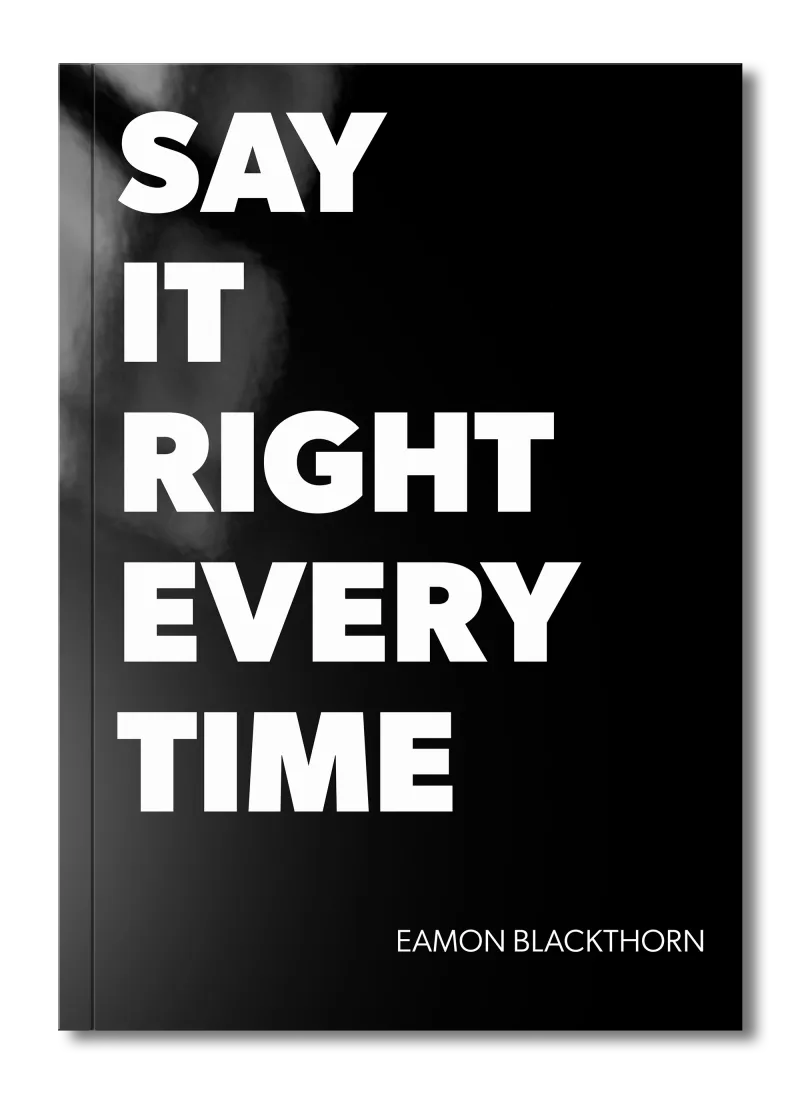
Stop rehearsing conversations you'll never have. Say It Right Every Time gives you 115 word-for-word scripts and 16 proven frameworks to speak with confidence in every conversation that matters.
The Foundation: What You Need Before You Start
Before you begin, there are three things that need to be clear.
Your intention must be growth, not release. In Say It Right Every Time, I write that feedback is a responsibility, not a right. Before you give feedback, ask yourself honestly: am I doing this to help this person and this team, or am I doing it to relieve my own frustration? If the answer is the latter, wait. Feedback delivered from irritation rarely serves the team, no matter how accurate the content.
You need clarity on the behavior, not the person. The single most important rule in any feedback conversation is to focus on what someone did, not who they are. "You interrupted three people in today's meeting" is specific, observable, and actionable. "You are dismissive" is a character assessment, and it will trigger defensiveness every time. Know exactly which behavior you are addressing before you open your mouth.
Psychological safety must already exist, or you must build it first. Honest feedback only travels in an environment where people trust that speaking and receiving the truth will not damage their standing. If your team does not yet have that foundation, the feedback process described here will help, but you will need to understand the role psychological safety plays in driving team synergy before you expect full results.
Get these right first. The steps that follow will not work without them.
Step 1: Check Your Intention and Prepare Specifically
This step is the one most people skip entirely, and it is the reason so many feedback conversations go sideways before a single word is spoken.
Before any feedback conversation, you need to do the internal work. Ask yourself three questions: What specific behavior am I addressing? What outcome do I want from this conversation? Am I genuinely trying to help? These are the three pre-conversation clarity questions I outline in Chapter 5 of Say It Right Every Time. A clear desired outcome must be specific, realistic, and actionable, not a vague hope that things improve.
- Write down the specific situation you are referring to before the conversation.
- Write one sentence describing the behavior you observed, without using adjectives that describe personality.
- State your desired outcome in one clear sentence: what do you want to be different after this conversation?
- Check your emotional state: if you are still angry or frustrated, give yourself time before you speak.
- Decide on the right setting: private, unhurried, and free from interruption.
Here is what this looks like in practice. A senior developer on a cross-functional team notices that a colleague has been delivering code without documentation for three consecutive sprints. Before raising it, she writes: "In sprints four, five, and six, the code submitted for the payment module had no accompanying documentation. The impact is that two other developers spent extra hours reverse-engineering the logic. I want to agree on a documentation standard going forward." That is preparation. That is not a complaint. That is a tool.
Preparation turns a reactive conversation into a purposeful one, and that shift changes everything for the team.
Step 2: Use the S.B.I. Method to Structure Your Message
Structure is what separates feedback that builds team synergy from feedback that quietly breaks it.
The S.B.I. Method, which I cover in detail in Chapter 8 of Say It Right Every Time, gives you a three-part framework: Situation, Behavior, Impact. You name the situation where the behavior occurred, you describe the observable behavior itself, and you explain the specific impact it had on the team or the work. Nothing more. This method works because it removes personal judgment from the equation entirely. The person receiving the feedback cannot argue with what was observed; they can only engage with it.
- Name the situation specifically: "In yesterday's client call..."
- Describe only what you observed, using neutral language: "You spoke over Sarah twice when she was presenting the timeline."
- State the impact on the team or the outcome: "The client looked confused, and Sarah went quiet for the rest of the call."
- Resist adding interpretation: do not say "You always do this" or "You clearly do not respect her."
- Close with a forward-looking question: "What would help you approach that differently next time?"
You can read more about how this method works across different team scenarios in How to Use the S.B.I. Method to Give Team Members Feedback That Unifies Instead of Divides. The key point is this: when a team adopts a shared method, feedback becomes a practice rather than an ordeal.
Step 3: Use the Empathy Bridge Before Delivering the Message
Here is where most people make their second critical error. They prepare their message carefully, then deliver it cold. And a cold delivery, no matter how accurate the content, triggers defensiveness before the other person has even processed what was said.
In Say It Right Every Time, I describe a technique I call the Empathy Bridge. It is simple: before you deliver your message, you acknowledge the other person's situation or feelings. You connect before you correct. This is not softening the truth. It is making space for the truth to actually land. The neuroscience is clear: a person who feels seen is physiologically less likely to react defensively.
- Open with a genuine acknowledgment: "I know this project has been under enormous pressure, and you have carried a lot of it."
- Name what you imagine they might be feeling, without presuming you are right: "I imagine you are probably stretched thin right now."
- Ask one question that shows you are listening before you deliver: "How are you feeling about how things are going?"
- Then move into your prepared S.B.I. feedback only after you have genuinely heard their answer.
- Keep the bridge short: two or three sentences, not a long preamble that delays the real conversation.
A script from Chapter 5 of Say It Right Every Time puts it this way: "I would like to talk about [topic]. It has been on my mind, and I think it is important that we discuss it. Do you have a few minutes to talk now?" That is the entry point. The Empathy Bridge is what comes immediately after, before your core message. Together, they create a conversation rather than a confrontation.
Step 4: Manage the Reaction Without Abandoning the Message
Even with the best preparation and delivery, feedback sometimes lands hard. The other person goes quiet, gets defensive, or pushes back. This is the moment most managers and colleagues retreat, and that retreat is what teaches the team that honest conversations are unsafe.
When emotions spike, your job is to stay present without escalating. I learned this the hard way, watching a conflict I had carefully prepared for unravel in seconds because I matched the other person's rising defensiveness with my own. A 3-Second Pause, as I describe it in Say It Right Every Time, interrupts that reactive cycle before it takes hold. You pause three seconds before responding. It sounds simple. Under pressure, it is one of the hardest things you can do.
- When the other person becomes defensive, resist the urge to repeat your point more firmly.
- Use the pause: "I can see this is bringing up some strong feelings. Give me a second."
- Acknowledge their reaction without abandoning your message: "I can see you are frustrated. That makes sense. I want us to work through this, not past it."
- If the conversation becomes unproductive, name that directly: "I think we are both too emotional right now. Can we agree to come back to this tomorrow at ten?"
- After the pause or the postponement, return to the behavior and impact without re-escalating.
Managing reactions well is the difference between feedback that closes a conversation and feedback that opens a team up to real growth. When your team sees you hold your ground with respect and calm, trust builds across the whole group.
Step 5: Teach the Team to Receive Feedback Using G.R.O.W.
Feedback is a two-sided exchange, and the receiving side is where most teams fall apart. People either collapse under critical feedback or dismiss it entirely. Neither response helps the team. I have long believed that if giving feedback is a craft, receiving it is a superpower.
The G.R.O.W. Method, outlined in Chapter 8 of Say It Right Every Time, gives people a four-part framework for turning feedback into a personal development plan: Goal, Reality, Options, Way Forward. After receiving feedback, the person identifies what their goal should be based on what they have heard, assesses the reality of their current situation, generates options for improvement, and commits to a specific way forward. This method transforms feedback from a verdict into a starting point.
- After receiving feedback, say thank you before you respond to anything else: "'Thank you for telling me that' is one of the most powerful phrases in the English language," as I write in the book.
- Identify the goal that emerges from the feedback: "Based on what you have said, it sounds like my main goal should be to improve how I communicate timelines to the team."
- Assess your reality honestly: "The reality is that I have missed two check-ins this month."
- Generate at least two options: "I could set a standing reminder, or I could ask you to include timeline updates as a standard agenda item in our weekly meeting."
- Commit to one specific way forward and name it: "I will set the reminder this afternoon and tell you by Friday if it is working."
You can explore how to build this into a broader improvement plan in How to Use the G.R.O.W. Method to Turn Team Feedback Into a Synergy Improvement Plan. When your whole team learns to receive feedback this way, the culture shifts from one of judgment to one of collective growth.
Step 6: Follow Up and Close the Loop
Feedback without follow-up is a conversation with no consequence. It sends a message: what we discussed does not really matter. And that message is corrosive to team synergy over time.
Following up is simple, but it requires you to remember what you agreed and act on it. It also signals to the person you spoke with that the conversation was genuine, not performative. I have seen teams where feedback was given regularly but never followed up on, and the result was that people stopped trusting the process entirely. They gave and received feedback as a ritual with no meaning.
- Within one week of the feedback conversation, check in briefly: "I just wanted to see how you are getting on with what we discussed."
- If progress has been made, name it specifically: "I noticed you left time for questions in today's presentation. That made a real difference."
- If nothing has changed, revisit the conversation without blame: "We talked about the documentation issue last week. I want to make sure it did not get lost. Where are you with it?"
- Create a simple feedback loop by scheduling a short review: ask the person to update you by a specific date.
- If you promised to do something in the feedback conversation, do it, and confirm to the other person that you have done it.
This step connects directly to what a healthy feedback loop looks like when it actually boosts team synergy. The loop only works when both parties close it.
Adapting This Process for Remote Teams
Remote teams require specific adjustments because the conditions that make feedback feel human are harder to replicate across a screen.
Choose the right medium deliberately. Text-based feedback, whether by message or email, strips out tone, expression, and nuance. For anything beyond a brief positive note, use video. Seeing a face makes it possible to read whether the message has landed as intended, and it gives the person receiving it a chance to respond in real time rather than stewing alone.
Build in more deliberate preparation time. In an office, you can read a room before you start a difficult conversation. Remotely, you cannot. Spend more time on your Clarity Checklist before the call: know your specific situation, behavior, and impact before you open the video link. Also consider asking the other person to block out time rather than dropping into a call unannounced, which immediately raises anxiety.
Manage the 3-Second Pause differently on video. Silence on a video call feels longer and more awkward than silence in person. If you need a pause, name it: "Give me just a moment." This normalizes the pause rather than creating confusion about whether the connection has dropped.
Follow up in writing after the call. A short written summary of what was agreed helps remote team members hold the thread between conversations. It does not need to be formal: a brief message that says "Good to talk today. To summarize, we agreed that..." is enough.
Use role clarity as your anchor. Ambiguity about responsibilities is magnified in remote teams, and it is a frequent source of conflict and poor performance. If feedback keeps surfacing around the same tension, you may need to revisit What Is Role Clarity and Why It Is the Foundation of Sustainable Team Synergy before another feedback conversation takes place.
The core process holds in every context. Only the execution changes.
Common Mistakes to Avoid
Let me tell you about the mistakes I see most often. I have made most of them myself.
The mistake: Giving feedback publicly, in front of the wider team.
Why it happens: The moment feels urgent, or the person assumes the team will benefit from hearing it too.
What to do instead: Correct behavior privately whenever possible. Public feedback almost always triggers shame rather than growth, and shame shuts down the very openness your team needs.
The mistake: Leading with "I feel like you always..." or "You never..."
Why it happens: We reach for the word "always" when we are frustrated, because it expresses the weight of a pattern.
What to do instead: Use I-statements and specific instances: "In last Thursday's meeting, I noticed..." Always and never are rarely accurate, and they signal a character judgment rather than a behavioral observation.
The mistake: Delivering feedback weeks after the event.
Why it happens: People wait for the right moment, which never arrives, and the feedback becomes a historical grievance.
What to do instead: Give feedback as close to the situation as possible. If you are still too emotional to speak clearly, wait a day, but not a week.
The mistake: Sandwiching criticism between two pieces of praise.
Why it happens: People genuinely want to soften the blow, and they have been told this is the kind way to do it.
What to do instead: Use the Empathy Bridge instead. It acknowledges the person without distorting the message or training them to dread your praise.
The mistake: Avoiding the difficult conversation entirely because things seem to have settled.
Why it happens: Human nature prefers temporary comfort over the risk of conflict.
What to do instead: Read Why Avoiding Difficult Conversations Is the Hidden Enemy of Team Synergy and understand that avoidance does not resolve tension; it simply delays and amplifies it.
These are not character flaws. They are gaps in the system. Fix the system.
Your Practical Checklist
Use this checklist before you begin and after each feedback conversation.
- I can name the specific situation, behavior, and impact before I speak.
- I have checked my intention: this is about growth, not frustration.
- I have chosen a private, unhurried setting for this conversation.
- I am prepared to use the Empathy Bridge before delivering my message.
- My feedback focuses on observable behavior, not personality or character.
- I have a specific, realistic desired outcome for this conversation.
- I know how I will manage my own emotions if the other person reacts defensively.
- I have a follow-up plan: a date, a check-in, or a specific marker of progress.
- I am prepared to listen and adjust if the other person shares new information.
- I can name the next step I want us to agree on before we finish the conversation.
- I have reviewed How to Start a Difficult Conversation That's Blocking Your Team's Synergy if this conversation involves significant conflict.
If you cannot check most of these, that is your starting point.
Summary and Next Steps
You now have a complete, structured process for giving and receiving feedback in a way that builds your team rather than quietly fracturing it. This is not about being softer or harder. It is about being more deliberate.
- Prepare before you speak: know the situation, the behavior, and the desired outcome before any feedback conversation begins.
- Check your intention honestly: feedback given from frustration helps no one and costs the team trust.
- Use the S.B.I. Method to keep your message grounded in observable behavior, not judgment.
- Deploy the Empathy Bridge to open the other person rather than trigger their defenses.
- Manage reactions with the 3-Second Pause: stay present, stay calm, stay in the conversation.
- Teach your team the G.R.O.W. Method so they receive feedback as a development tool, not a verdict.
- Follow up every time: a feedback conversation without a closed loop is a promise broken.
If this process feels like a lot at once, start with one step. Practice it until it becomes natural. Then add the next. That is how any real skill is built. For deeper reading, explore How Feedback Loops Boost Team Synergy to see how regular feedback creates the ongoing momentum that keeps teams sharp. You might also read How to Start a Difficult Conversation That's Blocking Your Team's Synergy for the scripts that get these conversations started cleanly.
Building real team synergy feedback into the daily life of your team is not glamorous work. But it is the work that separates teams that quietly drift apart from teams that grow stronger with every hard conversation they have the courage to complete.
Frequently Asked Questions (FAQ)
What is team synergy feedback and why does it matter?
Team synergy feedback is feedback delivered in a way that strengthens how a team works together, rather than creating division or resentment. It focuses on specific behavior, respects every person involved, and builds the trust that collective performance depends on. Poor feedback quietly destroys synergy over time.
How do you give feedback without damaging team synergy?
Use the S.B.I. Method: describe the Situation, name the Behavior you observed, and explain the Impact it had. Keep your language specific and focused on behavior, not character. Deliver feedback privately where possible, and always check your intention before you speak.
How does the S.B.I. Method support team synergy?
The S.B.I. Method removes vagueness and personal judgment from feedback. It anchors the conversation in observable facts, which reduces defensiveness and keeps the focus on improvement. When a whole team uses this method consistently, it builds a shared language that makes collaboration cleaner and trust stronger.
What is the role of psychological safety in team synergy feedback?
Psychological safety is the foundation that makes honest feedback possible. Without it, people withhold the truth to protect themselves, and synergy quietly erodes. When team members trust that they can speak and receive feedback without punishment, the team grows faster and functions at a higher level.
How do you receive feedback in a way that builds rather than breaks team synergy?
Start by saying thank you, even when the feedback is hard to hear. Use the G.R.O.W. Method to turn what you have heard into a personal development plan. Listen to understand, not to defend. The way you receive feedback sets the tone for how safe others feel giving it.
When is the best time to give feedback to preserve team synergy?
Give feedback as close to the event as possible, before emotions cool into resentment or the details blur. For sensitive matters, choose a private moment rather than a public one. Avoid giving feedback when either party is visibly emotional: let the heat pass first, then speak.