

What Happened
A recent business leadership report made the case that COOs perform best when they operate inside a structured framework built around four pillars: people, productivity, profits, and presence. The argument is that operational leaders without this kind of architecture tend to drift, reacting to fires instead of driving results. The piece positions this four-part model as a practical blueprint for turning the COO role into a genuine force inside an organization.
The Communication Angle
Here is what this framework gets right, and why most leaders butcher it anyway.
The four-pillar structure works because it solves the single biggest communication failure in senior leadership: vagueness. When a COO walks into a room and everyone has a different idea of what that person is responsible for, you have a communication breakdown before a single word is spoken. A named framework fixes that. It tells your team, your peers, and your CEO exactly where your attention lives. That is not a management trick. That is clarity, and clarity is the foundation of every effective working relationship.
But here is where most leaders go wrong with a framework like this. They announce it once, maybe in a town hall or a strategy deck, and then they assume the message landed. It did not. Repetition is not weakness. Repetition is how ideas become shared reality. The COOs who actually move organizations forward are the ones who reference their framework constantly, in one-on-ones, in board updates, in casual hallway conversations. They make the four pillars the lens through which every decision gets explained. That kind of consistency builds trust faster than any charm offensive.
The "presence" pillar deserves special attention because it is the one most executives fumble. Presence is not about being visible. It is about being legible. Your team needs to be able to read you. They need to know how you communicate under pressure, what signals you give when something is off track, and how you show up when the numbers are bad. Leaders who are emotionally inconsistent, warm one week and cold the next, create anxiety that bleeds directly into performance. Presence means your people can predict you. That predictability is a communication asset.
The productivity and profits pillars matter too, but they only work if the communication around them is concrete. Not "we need to improve efficiency." That sentence means nothing. Instead: "By Q3, each team lead will identify one process that can be cut or automated, and they will present the case to me directly." Specificity is the difference between a framework that inspires a nod and one that changes behavior.
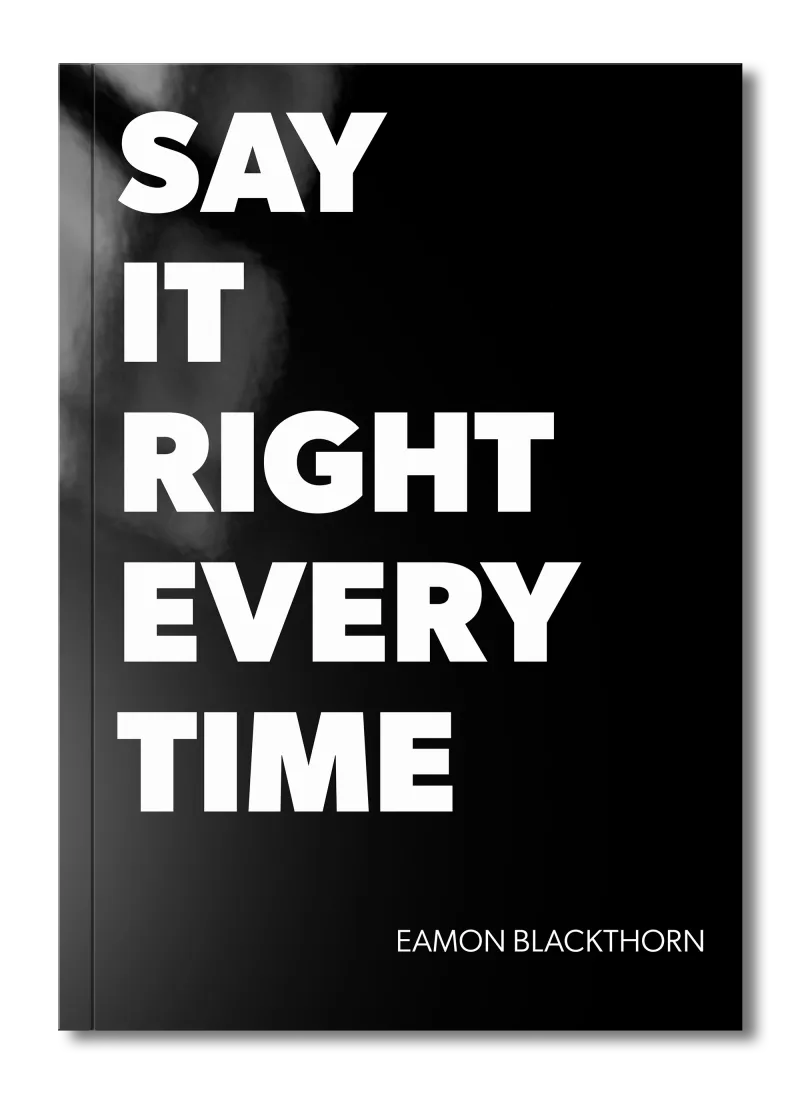
This is exactly the kind of scenario I break down in Say It Right Every Time. The chapter on structural clarity gives you a framework for turning abstract leadership principles into language your team can actually act on, because a strategy no one can repeat back to you is not a strategy. It is a wish.
Never Be Lost
for Words Again
Get word‑for‑word scripts for the conversations that shape your life, from job interviews and negotiations to difficult talks with family and partners, so you always know exactly what to say and how to say it.
Never Be Lost
for Words Again
Get word‑for‑word scripts for the conversations that shape your life, from job interviews and negotiations to difficult talks with family and partners, so you always know exactly what to say and how to say it.
Key Takeaway
Before your next team meeting, write down one sentence for each of the four pillars that describes what success looks like this quarter. Not a goal. A picture. "Productivity means every project has a named owner and a deadline by Friday." That sentence, said out loud in the meeting, does more work than a 20-slide deck.