

Skip to content
Illustration for AI Is Killing Your Communication Skills
Source: Let's Data Science

AI Is Killing Your Communication Skills

Eamon Blackthorn
By Eamon Blackthorn Author of the best-selling book Say It Right Every Time
3 min read Technology & AI
Listen to Story BETA

What Happened

Artificial intelligence tools are now being used by millions of people to write their emails, texts, and difficult conversations for them. What started as a productivity shortcut has quietly become a wholesale replacement for personal communication skills. People are increasingly letting machines speak for them, not just assist them, across both professional and personal contexts.

The Communication Angle

Here is the real comparison worth making: a person who writes their own difficult email versus a person who pastes the situation into ChatGPT and hits send on whatever comes back.

The first person sits with discomfort. They choose their words. They decide how much to reveal, how firm to be, where to soften. That process of deciding is not inefficiency. It is skill-building. Every word they wrestle with makes them sharper the next time they have to speak in a room where there is no AI to save them.

The second person gets a polished, grammatically perfect message that sounds like nobody. It is smooth in the way a hotel lobby is smooth. No edges, no personality, no real accountability. And here is the problem: the recipient can often feel it. There is a growing recognition that AI-generated communication has a particular tone, a kind of frictionless blandness that signals "I did not care enough to think about you specifically."

But the deeper damage is invisible. Every time you outsource a hard conversation to a machine, you lose a repetition. Communication is a physical skill, like a golf swing or a jump shot. You only get better by doing it badly first, then adjusting. When you hand that experience to AI, you are not saving time. You are spending skill.

The professionals who will win the next decade are the ones who can walk into a room and handle conflict, deliver bad news, negotiate, and inspire without a script generated by a tool. AI can be a drafting aid, the way a thesaurus is a drafting aid. Use it to check your tone, sharpen a phrase, or spot a gap. Do not use it to replace the thinking that makes you credible.

This is exactly the kind of scenario I break down in Say It Right Every Time. The chapter on owning your voice gives you a framework for developing a communication style that is distinctly yours, so that your words carry weight because people recognize the person behind them. No AI can replicate that, and no AI can build it for you.
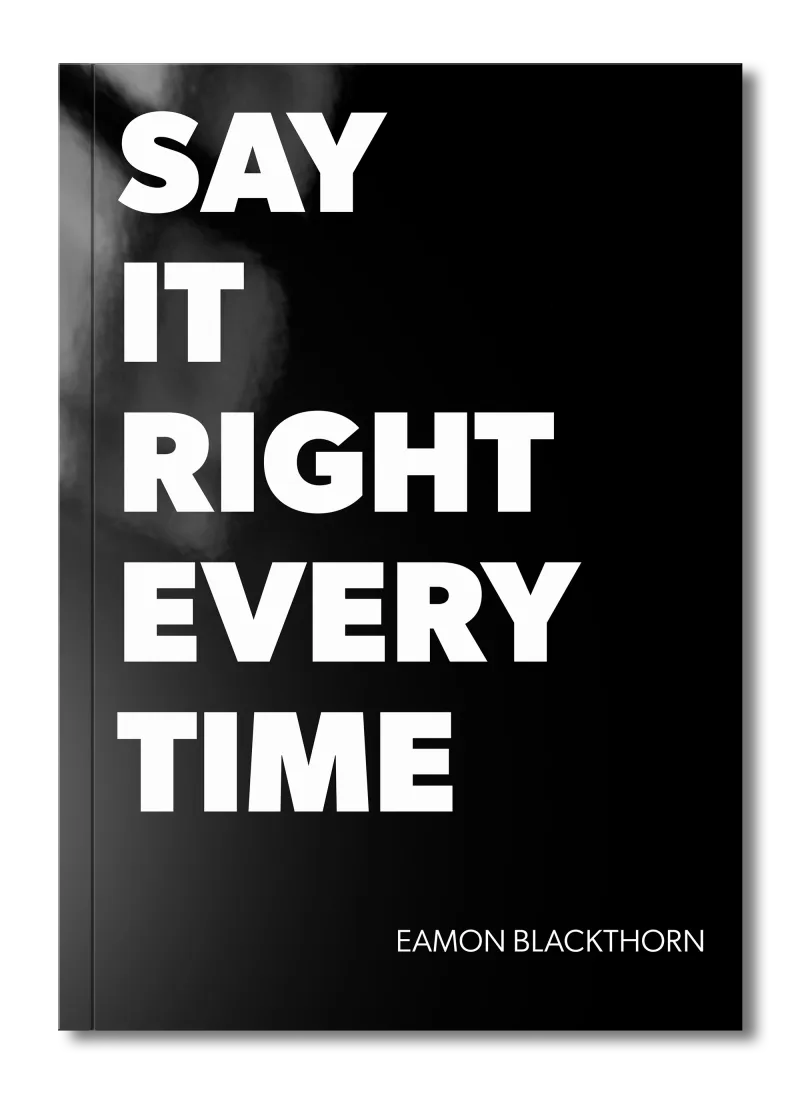
Say It Right Every Time by Eamon Blackthorn

Never Be Lost
for Words Again

By Eamon Blackthorn

Get word‑for‑word scripts for the conversations that shape your life, from job interviews and negotiations to difficult talks with family and partners, so you always know exactly what to say and how to say it.

Go to Book PageFrom $9.97 USD
PaperbackHardcoverKindleAudiobook
Say It Right Every Time by Eamon Blackthorn

Never Be Lost
for Words Again

By Eamon Blackthorn

Get word‑for‑word scripts for the conversations that shape your life, from job interviews and negotiations to difficult talks with family and partners, so you always know exactly what to say and how to say it.

Go to Book PageFrom $9.97 USD
PaperbackHardcoverKindleAudiobook

Key Takeaway

Before you use AI to write your next important message, write your own version first, even a rough one. Send that. Use AI afterward only to review what you sent and identify what you could have done better. This flips the tool from a crutch into a coach, and it means you keep the repetition that builds the skill.


More in Technology & AI

Illustration for What Amagi's CPO Gets Right About AI Leadership
Technology & AI

What Amagi's CPO Gets Right About AI Leadership

Amagi's Chief People Officer Prasad Menon sat down with People Matters to share his perspective on artificial intelligence in the workplace. His central argument: the technology itself is secondary. What determines whether AI helps or harms an organization is the quality of the leadership surrounding it. Menon framed AI not as a tool that replaces human judgment, but as something that reflects it back.

Illustration for AI Customer Service Is Tanking Insurance Reviews
Technology & AI

AI Customer Service Is Tanking Insurance Reviews

Trustpilot analyzed customer reviews across the insurance industry and found a striking divide. Reviews that mentioned AI interactions averaged just 2.47 stars. Reviews with no AI mention averaged 4.35 stars. The steepest damage came from one specific failure: companies that gave customers no clear route to a human agent lost nearly two full stars in satisfaction scores.

Illustration for AI Political Messaging: Where Ethics Draw the Line
Technology & AI

AI Political Messaging: Where Ethics Draw the Line

Build Canada, a political advocacy group, ran an AI-generated outreach campaign targeting Canadian voters, framing it as an "experiment" in modern political communication. The campaign sparked immediate backlash and renewed a debate about whether using AI to simulate authentic constituent voices crosses an ethical line. Critics and communication professionals are now questioning where legitimate persuasion ends and manufactured consent begins.

Illustration for What AI Tells Job Seekers About Your Company
Technology & AI

What AI Tells Job Seekers About Your Company

Job seekers are now turning to AI tools to research potential employers before they ever visit a careers page or talk to a recruiter. These tools synthesize Glassdoor reviews, news coverage, social media signals, and public data into a fast, confident narrative about what it is like to work somewhere. Companies that have ignored their digital reputation are discovering that AI has already written their employer brand story for them.

Illustration for AI Is Killing Your Communication Skills

Enjoyed this article?

AI Is Killing Your Communication Skills

Artificial intelligence tools are now being used by millions of people to write their emails, texts, and difficult conversations for them. What started as a productivity shortcut has quietly become a wholesale replacement for personal communication skills. People are increasingly letting machines speak for them, not just assist them, across both professional and personal contexts.

Share it with someone who needs to hear this.

Share