

What Happened
Regis Resources Limited held its Q3 2026 earnings call on April 22, 2026, with CEO Jim Beyer and CFO Michael Harvy Holmes leading the discussion. The call covered the Australian gold miner's quarterly financial performance and operational updates for investors and analysts. Like most earnings calls, it was a high-stakes communication event where every word choice either builds confidence or quietly erodes it.
The Communication Angle
Picture this: a room full of investors, analysts, and shareholders, all holding the same spreadsheet, all waiting for one thing. Not the numbers. They already have the numbers. They are waiting to find out what the numbers mean, and more importantly, whether the person speaking actually believes what they are saying.
That is the trap most executives fall into on earnings calls. They treat the call as a data delivery event. Read the results. Hand off to the CFO. Take questions. Done. But that approach is a slow leak in investor confidence, because data without narrative is just noise. When Jim Beyer stepped up to lead this call, the real job was not to report what happened. It was to make people feel oriented about where the company is going.
The most powerful communication tool in any earnings call is the forward frame. You do not open by looking backward at your quarter. You open by telling people what this quarter proves about your direction. There is a massive difference between saying "gold production was up 12 percent this quarter" and saying "this quarter confirms that our operational turnaround is ahead of schedule." Both sentences contain the same fact. Only one of them gives investors a reason to stay in the room mentally. The second sentence leads with meaning, not measurement.
There is also the question of how executives handle the hard parts. Every earnings call has a soft spot: a missed target, a rising cost line, a project running late. How a CEO navigates that moment tells you everything about their communication instincts. The wrong move is to bury the bad news in the middle of a long paragraph and surround it with positive language, hoping no one notices. Analysts always notice. And when they feel managed rather than informed, trust collapses fast. The right move is to name the problem early, own it cleanly, and immediately connect it to a specific corrective action. Short sentences. No spin. It reads as strength, not weakness.
Earnings calls also reward silence. Most executives are terrified of pauses. They fill every gap with filler phrases: "you know," "obviously," "at the end of the day." Strip those out and you sound twice as confident, because confident people are comfortable with space.
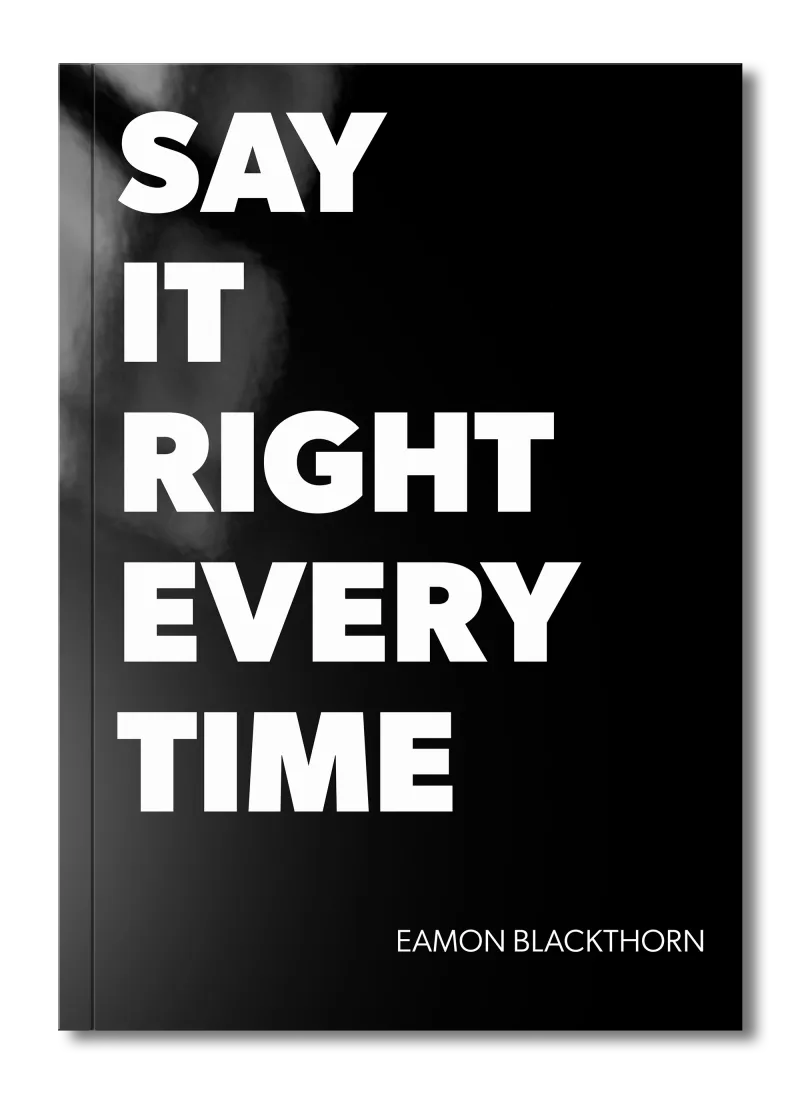
This is exactly the kind of scenario I break down in Say It Right Every Time. The chapter on high-pressure structured communication gives you a framework for sequencing information so that your audience hears meaning first and detail second. Most people get this backwards, and it costs them the room before they ever get to the good part.
Never Be Lost
for Words Again
Get word‑for‑word scripts for the conversations that shape your life, from job interviews and negotiations to difficult talks with family and partners, so you always know exactly what to say and how to say it.
Never Be Lost
for Words Again
Get word‑for‑word scripts for the conversations that shape your life, from job interviews and negotiations to difficult talks with family and partners, so you always know exactly what to say and how to say it.
Key Takeaway
Before your next high-stakes presentation or investor update, write one sentence that completes this phrase: "This result proves that we are..." That sentence becomes your opening frame. Everything else serves it. If you cannot finish that sentence clearly, you are not ready to present yet.