

What Happened
Harvard Law School's Forum on Corporate Governance published a piece examining what separates effective board leadership from its costly opposite. The core argument: how a board chair communicates with executives, shareholders, and fellow directors determines whether governance works or collapses. The stakes are not abstract. Poor board communication has preceded some of the most spectacular corporate failures in recent memory.
The Communication Angle
Here is the lesson, stated plainly: authority without clarity is just noise with a title.
Board chairs sit at the top of the organizational chart and assume that position earns them a communication pass. It does not. If anything, the higher the seat, the more disciplined your communication must be. Every word you say in that room carries disproportionate weight. Vague language from a chair does not read as open-minded. It reads as weak, or worse, evasive. Directors fill in the gaps themselves, and they never fill them in the same way.
The specific failure I see repeat itself in boardrooms is what I call "authority drift." A chair starts a meeting with a clear agenda, then gradually lets discussion wander because correcting course feels confrontational. By the end, no one agrees on what was decided, who owns it, or when it happens. That is not collaboration. That is an abdication of the chair's primary job: to make sure the group reaches a clear, shared conclusion.
The communication technique that fixes this is deceptively simple. At every decision point, the chair must state the conclusion out loud and ask for explicit confirmation. Not "does everyone agree?" which invites passive nodding. Instead: "We are deciding X, and the owner is Y, with a deadline of Z. Does anyone see it differently?" That phrasing forces anyone with a different read to speak up in the moment rather than contradict it in the hallway afterward.
The same discipline applies when a board chair communicates with a CEO. Too many chairs default to either rubber-stamp warmth or blunt criticism with no warning. Both are failures. Effective chairs give feedback in a specific structure: name the behavior, name the impact, name what they need to see instead. Short, clean, repeatable. A CEO who knows exactly where they stand performs better and stays longer. That is not a soft skill. That is governance.
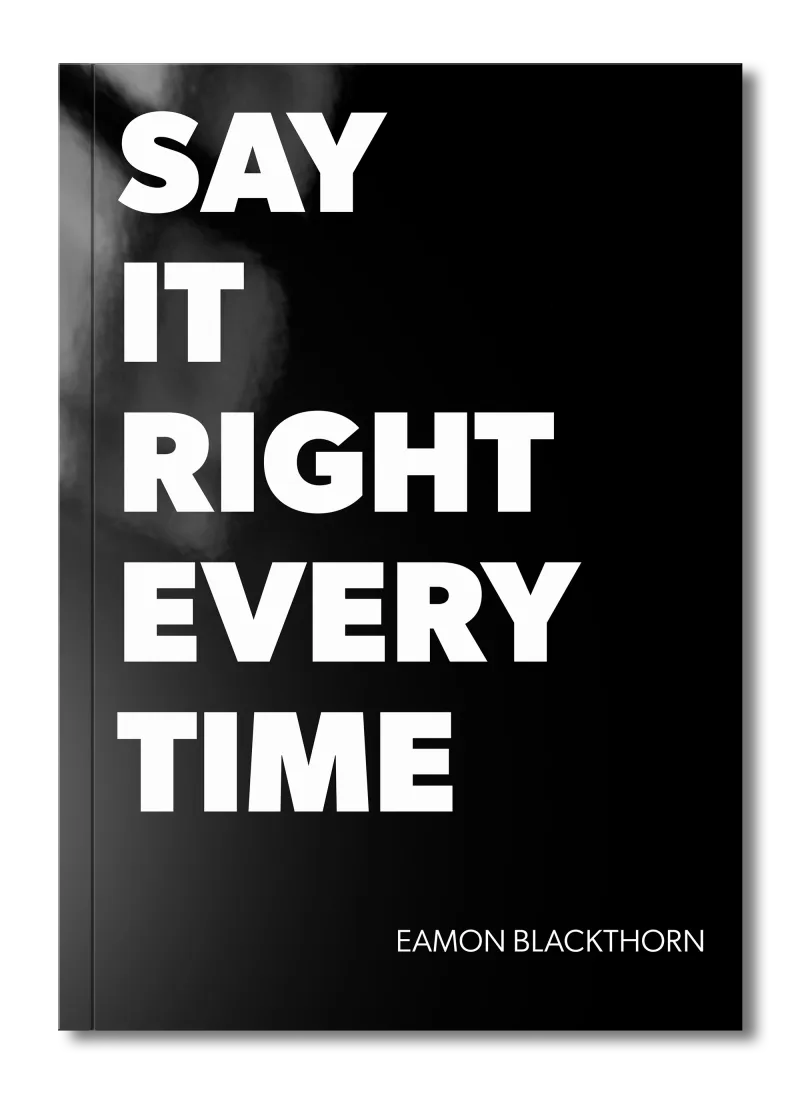
This is exactly the kind of scenario I break down in Say It Right Every Time. The chapter on high-stakes clarity gives you a framework for closing the loop in any group conversation, whether you are running a board, a team meeting, or a difficult one-on-one. The principle is the same at every level: the person with authority owns the summary. If you do not say it out loud, it did not happen.
Never Be Lost
for Words Again
Get word‑for‑word scripts for the conversations that shape your life, from job interviews and negotiations to difficult talks with family and partners, so you always know exactly what to say and how to say it.
Never Be Lost
for Words Again
Get word‑for‑word scripts for the conversations that shape your life, from job interviews and negotiations to difficult talks with family and partners, so you always know exactly what to say and how to say it.
Key Takeaway
Before your next meeting where a decision needs to be made, write the decision down in one sentence before the meeting starts. Bring that sentence into the room. At the end of the discussion, read it out loud and ask if the group agrees. If they change it, write the new version down immediately and read that back too. You will be shocked how often what people thought they agreed to is not what anyone else heard.