

What Happened
Gavi, the Vaccine Alliance, published a piece arguing that science communication is not a sidebar to scientific work. It is the work. The argument is that scientists who cannot explain their findings to the public are leaving their most important job unfinished. This is a position that sounds obvious but is still wildly controversial inside research institutions.
The Communication Angle
Here is the comparison that matters: the scientist who briefs a journalist with data dumps versus the scientist who tells a story with a single number at its center.
Watch how this plays out in practice. Scientist A gets asked about vaccine efficacy. She says: "The immunogenicity profile demonstrates a robust humoral response with 94.1% seroconversion rates across cohorts." Scientist B gets asked the same question. He says: "Nine out of ten people who got this vaccine built strong protection against the disease." Both are accurate. Only one of them works. Scientist B just did something most researchers consider beneath them. He translated.
The failure mode Gavi is pointing at is not dishonesty or incompetence. It is elitism. Many scientists believe that simplifying means distorting, and that the public should meet them at their level of complexity. This belief is not just wrong. It is professionally irresponsible. Your findings do not matter if no one acts on them. A vaccine that 80% of the public distrusts is not a scientific success. It is a communication failure dressed up in peer-reviewed language.
What Gavi is advocating for is the same discipline I see work in every high-stakes professional environment: lead with the point, follow with the proof. Scientists are trained to do the opposite. They build to the conclusion through layers of methodology and qualification. That approach works in a journal. It collapses in a press conference, a public health campaign, or a conversation with a skeptical neighbor.
The contrast here is sharp: researchers who treat communication as a translation problem they can hand off to a PR team versus researchers who own the translation themselves. The ones who own it build public trust. The ones who outsource it create a gap that bad actors are very happy to fill with simpler, louder, wrong answers.
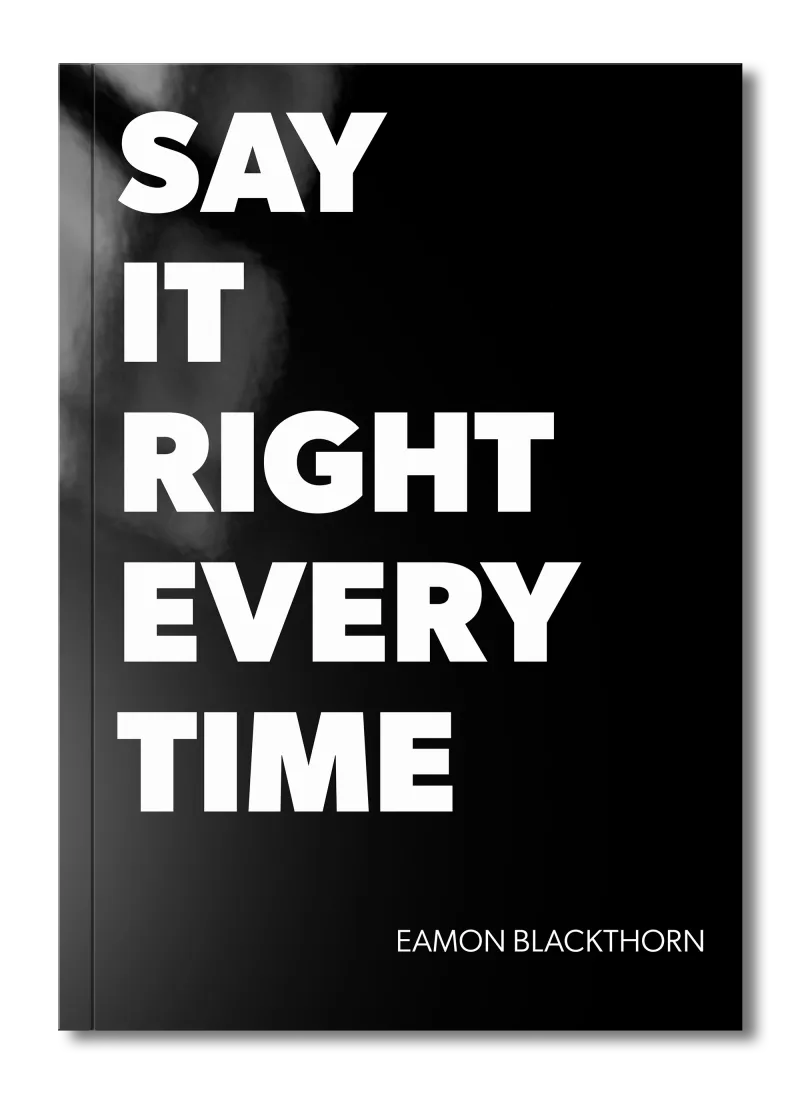
This is exactly the kind of scenario I break down in Say It Right Every Time. The chapter on audience calibration gives you a framework for identifying the gap between what you know and what your listener needs, and then closing that gap without losing accuracy or credibility. The goal is never to dumb things down. It is to respect your audience enough to meet them where they are.
Never Be Lost
for Words Again
Get word‑for‑word scripts for the conversations that shape your life, from job interviews and negotiations to difficult talks with family and partners, so you always know exactly what to say and how to say it.
Never Be Lost
for Words Again
Get word‑for‑word scripts for the conversations that shape your life, from job interviews and negotiations to difficult talks with family and partners, so you always know exactly what to say and how to say it.
Key Takeaway
Before your next presentation to a non-specialist audience, write one sentence that a twelve-year-old could repeat accurately to a friend. Not a summary. Not a bullet point. One sentence that captures what you want them to walk away believing. If you cannot write that sentence, you do not yet understand your own material well enough to present it. Start there.