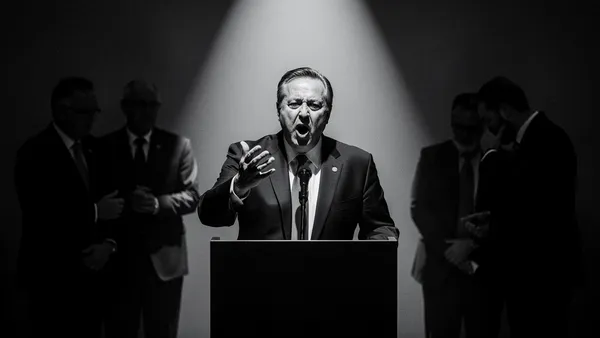

What Happened
Politicians across the spectrum are increasingly dropping profanity into speeches, interviews, and public statements. What was once career-ending is now almost strategic. Some see it as authenticity. Others see it as a race to the bottom. Either way, it is changing the baseline of what voters and professionals consider acceptable public language.
The Communication Angle
Here is the lesson before we get into the proof: shock value is a tool, not a strategy. The moment you rely on it, you have already lost control of your message.
Politicians who swear in public are making a calculated bet. They want you to feel like they are real, unfiltered, and not reading from a script. And sometimes it works, briefly. A well-placed expletive can cut through noise, signal conviction, and make a moment memorable. The problem is that most politicians using profanity are not doing it with precision. They are doing it because their actual words are not strong enough to carry the weight they need.
That is the tell. When someone swears to emphasize a point, ask yourself: what would happen if you removed the profanity? If the sentence collapses without it, the speaker has a vocabulary problem, not an authenticity problem. Strong communicators do not need the crutch. They build sentences where the idea itself is the punch. Think of the most persuasive people you know personally. Odds are they do not swear constantly. They choose words that land without needing a shock charge behind them.
Now here is where politicians get it half right. There is a real communication principle underneath this trend, and it is called register dropping. It means deliberately shifting your language to match your audience's register rather than speaking above it. That works. It builds connection. But there is a difference between simplifying your language to reach people and grabbing for profanity because you want to seem relatable. One is a skill. The other is a shortcut that signals insecurity about whether your actual message is strong enough.
The actionable version of this for professionals is simple: your language should match the emotional intensity of your content, not exceed it. If your content is strong, plain language will carry it. If you feel the urge to punch it up with something edgy or provocative, that is your signal to go back and strengthen the idea itself.
This is exactly the kind of scenario I break down in "Say It Right Every Time." The chapter on word economy gives you a framework for identifying which words in your sentences are doing real work and which ones are there to cover up weak thinking. Profanity is just the most obvious example of a filler strategy. There are subtler versions of the same problem showing up in every boardroom, every pitch, and every difficult conversation people think they are having but are actually just performing.
Never Be Lost
for Words Again
Get word‑for‑word scripts for the conversations that shape your life, from job interviews and negotiations to difficult talks with family and partners, so you always know exactly what to say and how to say it.
Never Be Lost
for Words Again
Get word‑for‑word scripts for the conversations that shape your life, from job interviews and negotiations to difficult talks with family and partners, so you always know exactly what to say and how to say it.
Key Takeaway
Before your next high-stakes presentation or difficult conversation, read your key points out loud and ask: does this sentence need anything added to make it land? If yes, rewrite the sentence until the idea is strong enough to stand on its own. You will never need a shortcut for a sentence that is already doing its job.