

What Happened
Corporate boards are no longer treating communication as a soft skill left to the communications department. A growing number of governance bodies are now requiring executives to rehearse their messaging before major corporate events, from earnings calls to merger announcements to crisis responses. This shift positions communication preparation not as polish, but as a formal risk management discipline sitting alongside legal and financial controls.
The Communication Angle
Picture this: a CEO walks into an earnings call having rehearsed nothing. She knows the numbers cold. She trusts her instincts. Forty-five minutes later, the stock is down six percent and Twitter is on fire. Not because the results were bad. Because she hesitated on one analyst's question, said "I'm not sure we're prepared to speak to that yet," and the market heard something she never said. It heard: something is wrong.
That scenario is not a cautionary tale. It is a Tuesday.
Boards mandating communication rehearsal are finally acknowledging what seasoned communicators have known for decades: under pressure, people do not rise to the occasion. They fall to their level of preparation. When stakes are high and cameras are rolling, the unrehearsed communicator defaults to filler language, vague positioning, and nervous qualifiers. Every one of those signals gets read by the audience, and none of them are read as confidence.
The specific skill boards are now buying is called pressure-testing. It is not about memorizing scripts. It is about sitting across from someone who will ask the worst version of every question, and forcing the executive to answer it cleanly, concisely, and without flinching. You find the holes before the analyst does. You find the moment the CFO goes sideways before the Bloomberg reporter does. You fix it in the room, not in the headline.
What makes this a genuine risk management move is the asymmetry of consequences. A well-rehearsed executive who fields a brutal question smoothly? Nobody writes about it. An executive who stumbles, hedges, or contradicts the press release in real time? That clip lives forever. Boards understand this math now. One bad earnings call can cost more in market cap than the entire annual communications budget. Rehearsal is not expensive. Recovery is.
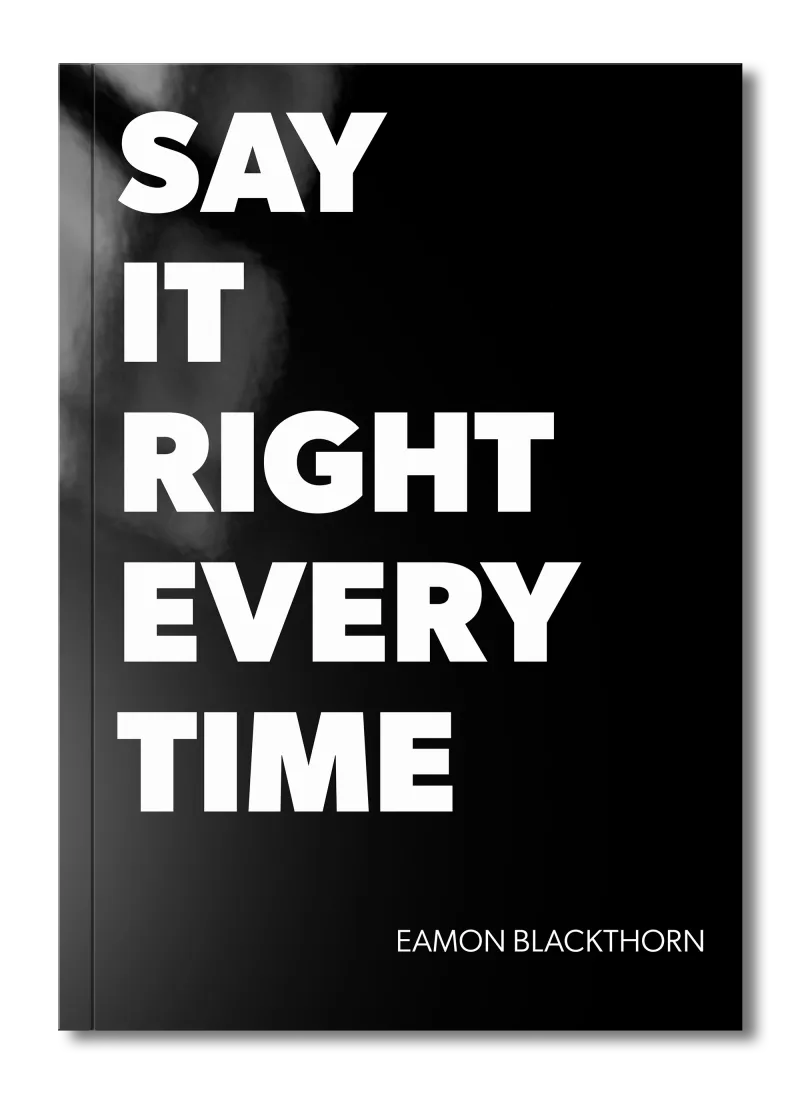
This is exactly the kind of scenario I break down in "Say It Right Every Time." The chapter on high-pressure delivery gives you a framework for building what I call a "response architecture," a way of structuring your answers to difficult questions so that no matter how the question comes at you, you have a clean entry point and a clear exit. It is not about spin. It is about preparation so thorough that calm becomes your natural state, not a performance.
Never Be Lost
for Words Again
Get word‑for‑word scripts for the conversations that shape your life, from job interviews and negotiations to difficult talks with family and partners, so you always know exactly what to say and how to say it.
Never Be Lost
for Words Again
Get word‑for‑word scripts for the conversations that shape your life, from job interviews and negotiations to difficult talks with family and partners, so you always know exactly what to say and how to say it.
Key Takeaway
Before your next high-stakes presentation, earnings call, or difficult announcement, do this one thing: find someone whose job is to disagree with you, give them the three questions you most hope nobody asks, and make them ask those questions as aggressively as they can. Answer out loud, not in your head. Do it twice. The version of you that walks into that room after that exercise is a fundamentally different communicator than the version who walks in cold.