

What Happened
Gap's CEO recently made a deliberate move to tie the brand's cultural identity back to specific, measurable business targets. Rather than speaking in vague terms about "relevance" or "heritage," the CEO framed Gap's cultural moment as a direct driver of financial recovery. It was a public statement with teeth, and that alone makes it worth examining.
The Communication Angle
Picture a CEO standing at a podium with two maps. One shows where the brand lives in the culture. The other shows where the numbers need to go. Most leaders keep those maps in separate rooms. Gap's CEO put them on the same table, and that decision is the whole story.
This is rarer than it sounds. Corporate turnaround communication usually splits into two failure modes. Either the leader talks pure financials and sounds like they're reading a spreadsheet to a room full of shareholders, or they go full brand vision and float away into language that sounds good but commits to nothing. Gap's CEO threaded the needle. Cultural relevance was named as a mechanism, not a mood. That is a specific, defensible claim.
Why does that work? Because audiences, whether they are investors, employees, or journalists, are trained to distrust abstraction. When a leader says "we are reconnecting with culture," every skeptic in the room starts counting the seconds until something concrete follows. Gap's CEO gave them something concrete. The bridge between "people care about this brand again" and "here is what that means for our numbers" is exactly the bridge that most communicators never bother to build.
There is also a sequencing lesson here. The CEO opened with cultural relevance and moved toward financial targets, not the reverse. That order matters enormously. Leading with numbers in a turnaround story puts you on defense immediately. You are explaining a hole. Leading with cultural momentum puts you on offense. You are describing a wave. Then you attach the numbers to the wave, and suddenly the numbers feel like confirmation rather than confession.
The practical application is simple. Before your next leadership address, ask yourself: what is the story I am telling, and what is the proof I am offering? If the story and the proof feel like two separate speeches stitched together, they are. The goal is one continuous argument where each sentence earns the next.
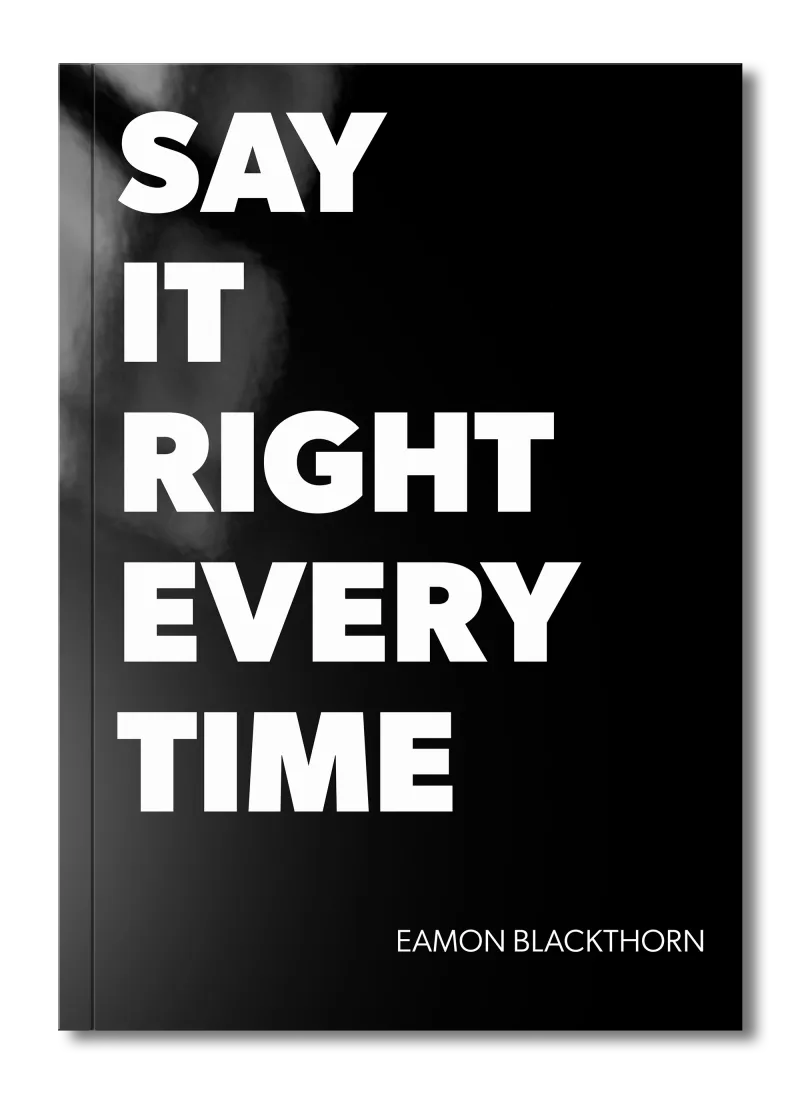
This is exactly the kind of scenario I break down in Say It Right Every Time. The chapter on structure and sequencing gives you a framework for deciding which piece of information earns trust first, so that by the time you make your big claim, your audience is already nodding instead of crossing their arms. Gap's CEO instinctively got the order right. You should not have to rely on instinct.
Never Be Lost
for Words Again
Get word‑for‑word scripts for the conversations that shape your life, from job interviews and negotiations to difficult talks with family and partners, so you always know exactly what to say and how to say it.
Never Be Lost
for Words Again
Get word‑for‑word scripts for the conversations that shape your life, from job interviews and negotiations to difficult talks with family and partners, so you always know exactly what to say and how to say it.
Key Takeaway
Before your next presentation or public statement, write two sentences side by side. The first names your narrative claim (the cultural or strategic story you want people to believe). The second names the specific, measurable outcome that proves it. If those two sentences feel unrelated, rewrite them until they lock together. Do not present until they do.