

What Happened
Corporate boards are waking up to something communication professionals have known for years: how a CEO speaks is not a personality quirk, it is a business liability. Governance experts and institutional investors are now treating executive communication failures as a measurable risk, on par with financial misreporting or compliance gaps. The soft skill label is officially dead.
The Communication Angle
Let's start with the event that proves this point every time I use it in a workshop. A major public company's CEO fumbles an earnings call. The numbers are fine. The story falls apart. Investors panic. The stock drops. Nothing changed in the business. The words changed. That is not a soft skill problem. That is a capital markets problem.
Here is what actually happens when executive communication fails at the governance level. It is not one bad sentence. It is a pattern of vague positioning, reactive messaging, and the complete absence of what I call a "north star statement." Every organization needs one clear, repeatable statement of direction that every leader can say consistently, under pressure, in front of any audience. Most companies do not have one. Their executives improvise. Improvisation under pressure produces contradiction. Contradiction produces distrust. Distrust produces risk.
The second failure is audience blindness. Executives are often brilliant operators who never stop to ask: who is in this room and what do they need to hear? A message calibrated for an internal all-hands will destroy you in front of an analyst. A message built for a regulatory hearing will bore your employees into disengagement. Governance-level communication requires a leader to hold multiple audience profiles in their head at the same time and speak in a way that threads them together. That is a trainable skill. Most companies do not train it.
Third, and this is the one that actually gets boards nervous: the absence of crisis communication architecture. Organizations build financial controls, legal review processes, and compliance frameworks. Almost none of them build a structured communication protocol for when things go wrong. So when the moment comes, the CEO wings it. Winging it in a crisis is how a manageable problem becomes an existential one. The board is right to be alarmed.
The fix is not a media trainer who teaches you to smile and pause. The fix is treating communication as a system. Clear message architecture. Audience mapping before every major statement. A rehearsed crisis communication protocol that gets tested before you need it. These are concrete, buildable things.
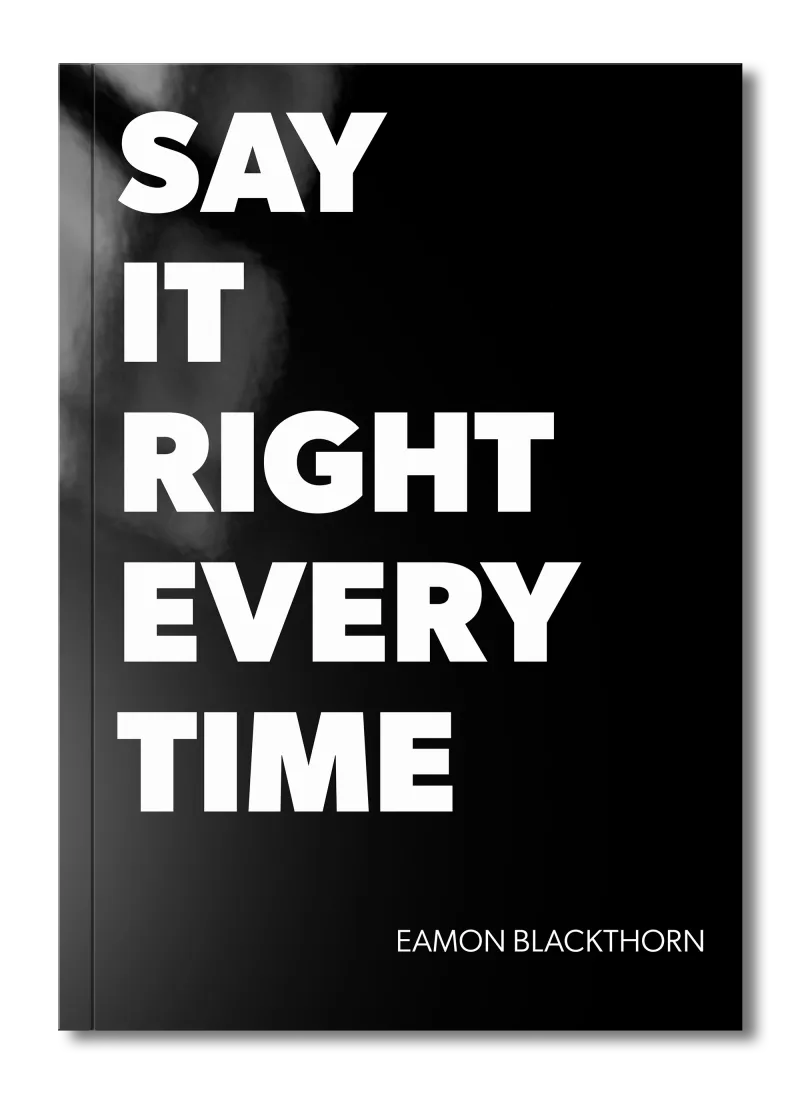
This is exactly the kind of scenario I break down in Say It Right Every Time. The chapter on message architecture gives you a framework for building that anchor statement from the ground up, so it holds under pressure, survives cross-examination, and stays consistent no matter who on your leadership team is delivering it. Governance risk from communication failures is not theoretical. It is a repeatable, preventable problem. Treat it like one.
Never Be Lost
for Words Again
Get word‑for‑word scripts for the conversations that shape your life, from job interviews and negotiations to difficult talks with family and partners, so you always know exactly what to say and how to say it.
Never Be Lost
for Words Again
Get word‑for‑word scripts for the conversations that shape your life, from job interviews and negotiations to difficult talks with family and partners, so you always know exactly what to say and how to say it.
Key Takeaway
Before your next high-stakes communication moment, whether it is a board presentation, an earnings call, or a difficult press statement, write down one sentence that answers this question: what is the single thing I need the audience to believe when I am done? Not a list. One sentence. That sentence is your anchor. Every word you say should pull toward it. If a sentence does not serve that anchor, cut it.