
In Short
After reading this, you will know exactly how to model effective feedback behavior in a way your team can observe, trust, and follow.
- Give feedback that is specific, timely, and focused on behavior rather than personality
- Receive feedback openly so your team sees that honest communication is safe
- Practice consistently, not just when performance slips
Effective feedback behavior is the practice of giving and receiving workplace feedback in a way that is specific, timely, and grounded in observable actions. It creates clarity about what is working, what needs to change, and what the path forward looks like.
I once watched a manager pull someone aside after a client presentation and say, "That could have gone better." That was it. No specifics, no guidance, no follow-up. The person walked away confused and a little humiliated. The manager thought he had given feedback. He had given nothing except doubt.
Most leaders struggle with effective feedback behavior not because they lack caring, but because they lack a clear structure for delivering honest observations without damaging trust. Fear plays a large part. Fear of conflict, fear of getting it wrong, fear of being disliked. So they soften the message until it disappears, or they harden it until it stings. Neither works.
In this guide, you will get a clear, practical process for feedback skills that you can apply immediately, whether you are addressing underperformance, recognising strong work, or asking your team to tell you the truth about how you are leading. If you want to understand why the culture around feedback matters so deeply, What Is Psychological Safety and How It Drives Team Synergy is worth reading first.
Why Giving and Receiving Feedback Is Harder Than It Looks
Knowing that feedback matters does not make it easy to deliver well. Every leader I have ever worked with understood, in theory, that regular honest feedback was essential. Very few of them did it consistently or well. There is a gap between knowing and doing, and that gap is wider here than in almost any other communication skill.
Here is what makes it genuinely difficult:
You carry the weight of the relationship. Feedback does not happen in a vacuum. It happens between two people who have history, status differences, and a working future together. The stakes feel high because they are high.
Most people were never taught how. You learned to lead by watching others lead. If the people above you avoided hard conversations or delivered clumsy criticism, that is the model you absorbed. You are working against inherited habits.
Vague feedback feels kinder in the moment. Saying "great job today" is easier than explaining specifically what was great and why it mattered. Saying "think about your tone" is easier than naming the exact behavior that caused a problem. Precision takes courage.
Receiving feedback gracefully is its own skill. Leaders who get defensive, dismissive, or withdrawn when they receive criticism send a powerful signal. Their team learns that feedback flows one way only.
Timing is genuinely difficult. Too soon and emotions are raw. Too late and the moment has lost its meaning. Finding the right window takes judgment and practice.
People confuse feedback with evaluation. When feedback only arrives at performance review time, people start to experience it as a verdict, not a conversation. That association is hard to break.
The goal is not to eliminate these difficulties. It is to build a system that works in spite of them.
"The Conversation You're Avoiding Is the One You Need to Have."
"The Conversation You're Avoiding
Is the One You Need to Have."
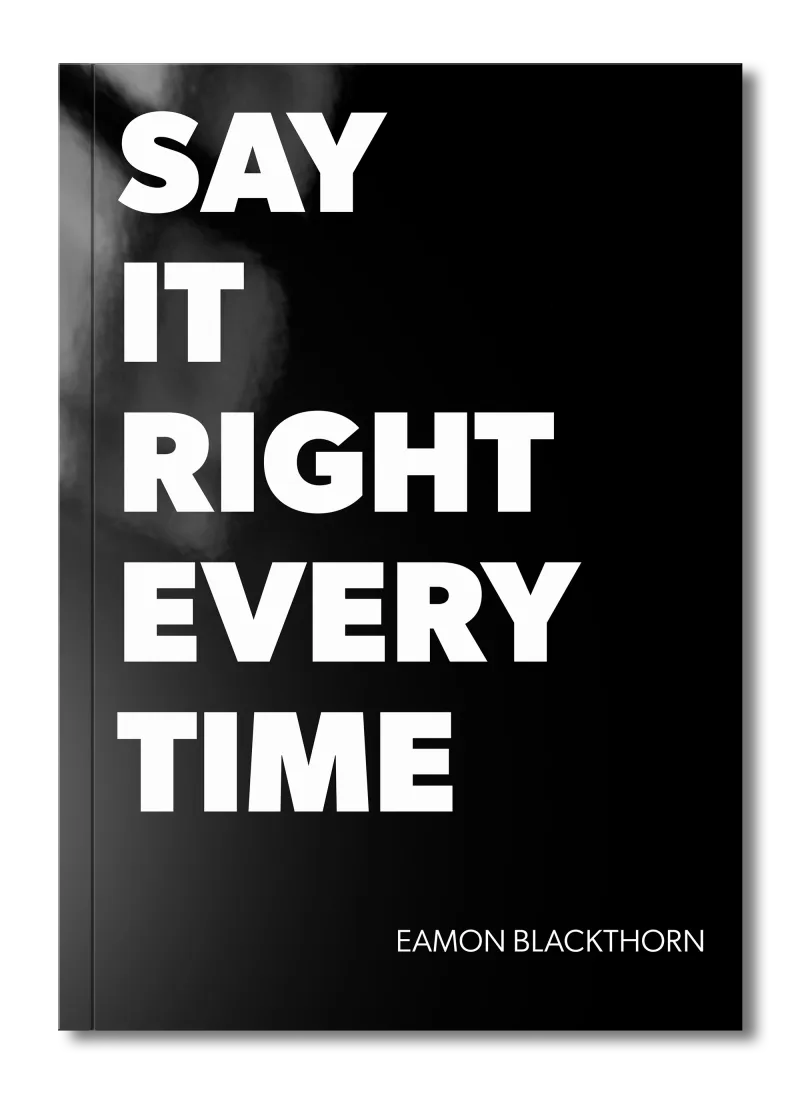
Stop rehearsing conversations you'll never have. Say It Right Every Time gives you 115 word-for-word scripts and 16 proven frameworks to speak with confidence in every conversation that matters.
The Foundation: What You Need Before You Start
Before you begin, there are three things that need to be clear.
Your intention must be genuine. Feedback given to manage your own discomfort, to assert dominance, or to cover yourself if something goes wrong later is not feedback. It is noise. Before any feedback conversation, ask yourself: am I giving this because it will help this person? If the answer is no, pause and reset. The person in front of you will sense your real motive, even if they cannot name it.
You need specific, observable information. "You need to be more professional" is not feedback. It is a verdict without evidence. Effective feedback behavior depends on concrete examples: what was said, what was done, in which situation, and what impact it had. Before you sit down with someone, be able to answer those four questions with precision.
The environment must feel safe enough for honesty. If your team has learned that feedback leads to punishment, embarrassment, or being dismissed, they will not engage with it honestly. You cannot model good feedback behavior in an environment that punishes openness. Read about how psychological safety enables honest communication if you are unsure whether your team is there yet.
Get these right first. The steps that follow will not work without them.
Step 1: Choose the Right Moment
The timing of feedback shapes everything that follows.
Feedback given in the heat of the moment often lands as an attack. Feedback given three weeks after the event lands as irrelevant. The right window is usually within 24 to 48 hours, once the immediate emotional charge has settled but while the details are still fresh for both of you.
You also need to consider the setting. A corridor, a group chat, or an open-plan floor are not suitable for honest developmental feedback. Respect demands privacy for difficult conversations.
- Identify the earliest appropriate moment to have the conversation, typically within 48 hours of the event.
- Choose a private setting where the person will not feel exposed or observed.
- Ask permission before you begin: "I would like to share some observations from yesterday. Is now a good time?"
- If the person is clearly upset or defensive before you start, reschedule rather than push through.
- Block time in your calendar specifically for feedback conversations, rather than fitting them between other tasks.
Example: A team member presented a proposal to a client that contained a significant error. You noticed it. The same afternoon, you send a message: "Do you have 15 minutes tomorrow morning? I want to talk through the presentation while it is fresh." The next morning, in your office with the door closed, you begin: "I wanted to talk about the figures in the proposal. Can you walk me through how you arrived at those numbers?" You start with curiosity, not accusation, and you have created the right conditions for an honest exchange.
Getting the moment right does not guarantee the conversation goes well. But getting it wrong almost guarantees it goes badly.
Step 2: Ground the Feedback in Specific Behavior
This is where most feedback falls apart. Generalities wound without informing. Specifics teach.
Your feedback must describe observable behavior, not inferred character. There is a significant difference between "you were dismissive in the meeting" and "when Sarah raised her concern, you interrupted her twice and moved on without acknowledging what she said." The second version is something the person can actually work with.
The S.B.I. method (Situation, Behavior, Impact) gives you a clear structure for doing this well.
- Describe the situation: when and where it happened.
- Name the specific behavior: what you observed, not what you interpreted.
- State the impact: what effect it had on the work, the team, or the client.
- Avoid the words "always," "never," "typical," and "attitude." These trigger defensiveness without adding precision.
- Stay in the first person: "I noticed," "I observed," "I heard."
When you ground feedback in behavior rather than personality, you give the person something real to change. You also protect the relationship, because you are not attacking who they are. You are describing what they did.
Step 3: Deliver It Directly and With Respect
Courage is the skill that most feedback conversations actually require.
Many leaders bury the real message under so much reassurance that the person walks away unsure anything needed to change. Others deliver it so bluntly that the person hears only criticism and shuts down. Direct and respectful are not opposites. You can be both at once.
- Lead with the substance, not a lengthy preamble. If you need to address a problem, say so clearly within the first two minutes.
- Keep your tone steady and calm. Emotional volatility signals to the person that the conversation is about your feelings, not their development.
- Do not apologise for giving feedback. Saying "sorry, I hate to say this but..." signals that honest communication is something to feel guilty about.
- Invite response after you have finished. "What is your take on this?" or "How did that land for you?"
- If the person becomes emotional, pause. Acknowledge what you are seeing: "I can see this is hard to hear. Take a moment."
Example: You have noticed that a senior team member consistently talks over junior colleagues in team meetings. You say: "I want to share something I have been observing in our weekly meetings. When the junior members of the team start to speak, I have noticed you often begin talking before they have finished. The impact I have seen is that they stop contributing. I do not think that is your intention, and I want us to talk about it." You name the behavior, you name the impact, and you leave space for their response. That is effective feedback behavior done with strength and respect.
After this step, the person has heard the message clearly. Now your job is to listen.
Step 4: Listen to the Response Without Defending
This is the step leaders most often skip, and it is the one that decides whether the conversation builds trust or erodes it.
When you give feedback and then hold the floor for the rest of the conversation, you are not giving feedback. You are delivering a verdict. Real feedback is a two-way exchange. The person receiving it may have context you do not have. They may have a perspective that changes how you understand what happened. Give them the space to share it.
- After you deliver your observation, stop talking and wait. Resist the urge to fill the silence.
- Listen without preparing your counter-argument while they speak.
- Acknowledge what you hear before responding: "That makes sense," or "I had not considered that."
- If they raise a point that genuinely shifts your view, say so out loud. That is not weakness. It is credibility.
- If you disagree with their explanation, you can say so calmly: "I hear that, and I still think the impact on the team was real. Can we talk about that?"
When you listen well during a feedback conversation, you model the same behavior you are asking your team to practice. That consistency is what builds trust over time.
Step 5: Ask for Feedback on Your Own Leadership
Here is the truth of it: you cannot build a feedback culture if you are not willing to participate in it yourself.
When leaders ask for honest feedback on their own performance, they do something no policy or training program can do. They demonstrate that receiving critical observations is safe. They show that rank does not exempt anyone from the desire to improve. And they get genuinely useful information that they would never receive if they did not ask.
- Once a month, ask one team member a specific question: "What is one thing I could do differently that would make your work easier?"
- When you receive the answer, listen without justifying or explaining yourself. Simply say, "Thank you. That is helpful."
- Follow up on what you were told. If someone says you are slow to make decisions, address it visibly and name it: "You said I take too long. I want to do better at that."
- Model composure when you receive criticism that stings. Your body language teaches as much as your words.
- Acknowledge publicly when feedback from your team changed how you lead: "Someone told me I was not clear enough in my briefings. They were right."
Example: At the end of a team meeting, you say: "Before we close, I want to ask something. I have been trying to run these meetings more efficiently. What is one thing I could do differently?" A team member says, "Honestly, you sometimes go back over things we already decided. It slows us down." You nod. You say, "Fair point. I will watch for that." Nothing more. Next week, you keep the meeting focused. They notice. That one exchange teaches more about effective feedback behavior than a month of workshops.
Adapting This Process for Remote and Hybrid Teams
Remote and hybrid environments create specific friction for feedback conversations that is worth addressing directly.
Without face-to-face contact, the visual and tonal cues that soften difficult messages are harder to read and easier to misinterpret. A brief message saying "can we talk?" lands very differently on a screen than it does when said in passing in a hallway.
Use video for anything substantive. Text and email strip tone from feedback entirely. If the conversation matters enough to have, it matters enough to have on a video call with cameras on. Eye contact, even through a screen, changes the nature of the exchange.
Build in explicit check-ins. Remote team members may go weeks without any direct feedback from their manager because the natural moments of informal observation do not exist. Schedule short, regular one-to-one calls specifically for development conversations, separate from project updates.
Be more explicit about impact. In a shared office, the effect of someone's behavior on the team is often visible. Remotely, you need to name it clearly because the person cannot see it themselves: "I want to tell you what I have been hearing from others on the team since the decision was made."
Acknowledge the distance. It is worth saying directly: "I know it is harder to read tone over a video call, so I want to be clear that I am sharing this because I respect your work and I want to help."
Invite more frequent feedback from remote team members. Isolation can make people feel invisible. Asking specifically, "Is there anything I could be doing better as a remote manager?" signals that you are paying attention and that they matter.
The core process for effective feedback behavior does not change in a remote environment. Only the execution changes.
Common Mistakes That Undermine Feedback in the Workplace
Let me tell you about the mistakes I see most often. I have made most of them myself.
The mistake: Softening the message until it disappears.
Why it happens: Leaders want to preserve the relationship and avoid causing distress.
What to do instead: Trust the person to handle honesty. Vague feedback insults their capacity to grow. Be direct, be kind, and be clear.
The mistake: Waiting too long after the event.
Why it happens: The moment never feels quite right, so the conversation keeps getting deferred.
What to do instead: Set a personal rule: if feedback is worth giving, give it within 48 hours. Imperfect and timely beats polished and late.
The mistake: Giving feedback only when something goes wrong.
Why it happens: Positive performance feels like it does not need addressing.
What to do instead: Recognise specific strong work with the same precision you apply to problems. "Good job" is not feedback. "The way you handled the client's objection in that meeting was exactly what we needed" is feedback.
The mistake: Responding defensively when you receive feedback yourself.
Why it happens: Criticism triggers a protective instinct, especially in front of direct reports.
What to do instead: Pause before responding. Treat their input as data, not a verdict. Your composure in that moment is visible to everyone watching.
The mistake: Mixing feedback with performance evaluation language.
Why it happens: Annual review cycles have trained leaders to connect feedback with consequences.
What to do instead: Separate the developmental conversation from the evaluative one. Feedback in the moment should feel like coaching, not scoring.
These are not character flaws. They are gaps in the system. Fix the system.
Your Practical Checklist for Modeling Feedback Behavior
Use this checklist before you begin and after each cycle.
- I have identified a specific behavior to address, not a general impression.
- I have chosen a private setting and confirmed the timing works for both of us.
- I can describe the situation, the behavior, and the impact without using character judgments.
- I have asked permission to share the feedback before beginning.
- I have prepared to listen to the response without preparing my rebuttal in advance.
- I have given positive feedback this week with the same specificity I apply to problems.
- I have asked at least one team member for honest feedback on my own leadership this month.
- I have followed up on a previous feedback conversation to check progress.
- I am modeling the composure I want my team to practice when receiving criticism.
- I have not clustered all feedback into a single performance review conversation.
If you cannot check most of these, that is your starting point.
Summary and Next Steps
You now have a working process for modeling effective feedback behavior as a leader, one grounded in specific observation, delivered with courage, and built around two-way communication rather than one-way judgment.
- Timing and setting are not optional details. They shape whether the message lands or gets lost.
- Specific behavioral language is the difference between feedback that teaches and feedback that wounds.
- Delivering feedback directly is an act of respect, not aggression.
- Listening to the response without defending makes the conversation real.
- Asking for feedback on your own leadership is the single most powerful signal you can send.
- Consistency over time matters more than perfection in any single conversation.
- The team learns from what you do, not what you say you believe.
For a deeper look at how feedback flows through team culture, How Feedback Loops Boost Team Synergy is worth reading next. If you want to understand how your communication style affects the overall health of your meetings, The Role of Communication in Meeting Success covers that ground well. And if you are working to build a team culture where honesty is the norm, How Leaders Foster a Culture of Team Synergy will give you the broader framework.
Effective feedback behavior is not a talent some people are born with. It is a practice built one honest conversation at a time, and there is no better day to start than today.
Frequently Asked Questions (FAQ)
What is effective feedback behavior in the workplace?
Effective feedback behavior is the practice of giving and receiving workplace feedback in a way that is specific, timely, and focused on observable actions rather than character. It involves clear delivery, genuine listening, and consistent follow-through. Leaders who model it set the standard for their entire team.
How do leaders model effective feedback behavior for their teams?
Leaders model effective feedback behavior by practicing it visibly and consistently, not just talking about it. They give specific, timely feedback, ask for feedback on their own performance, and respond to criticism without defensiveness. Their behavior teaches the team what good feedback looks like in practice.
Why is modeling feedback behavior important for leaders?
When leaders model feedback behavior, they signal that honest communication is safe and expected. Teams take their cues from what leaders do, not what they say. A leader who avoids difficult conversations teaches avoidance. A leader who engages directly teaches directness.
How do you give feedback that is specific and effective?
Effective feedback describes a specific situation, names the observable behavior, and explains the impact it had. It avoids generalizations like "always" or "never," focuses on the action rather than the person, and is delivered as close to the event as practical. How to Give Feedback That Strengthens Team Synergy covers this in more detail.
What are the most common mistakes leaders make when giving feedback?
The most common mistakes include being vague, waiting too long after the event, making feedback personal rather than behavioral, and only giving feedback when something goes wrong. Leaders also frequently forget to ask for feedback themselves, which weakens the culture they are trying to build.
How does feedback behavior affect psychological safety in a team?
When leaders give feedback consistently and respectfully, team members learn that honest communication does not carry personal risk. This creates the psychological safety needed for people to raise problems, admit mistakes, and challenge ideas. Without safe feedback behavior at the top, teams go quiet.