
In Short
After reading this guide, you will be able to use your body deliberately and confidently in professional conversations and presentations.
- Posture and stillness form the foundation of all confident physical expression.
- Gesture, eye contact, and facial expression must work together, not separately.
- Small, consistent practice in low-stakes settings builds lasting physical presence.
Confident body language is the intentional use of posture, gesture, eye contact, and movement to reinforce your spoken message and project presence. It means your physical signals align with your words so others receive your communication clearly and trust what they are hearing.
You had something important to say. You said it. But the room did not respond the way you hoped. Someone talked over you. The decision went another way. Afterwards, a colleague said, "You seemed nervous." You were not nervous. You were prepared. But your body told a different story.
This is one of the most common frustrations I hear from people working on their communication skills. They invest real effort in what they say. They prepare their arguments. They choose their words carefully. But they give almost no thought to how their body delivers those words, and that gap costs them.
Physical expression is not about performance or pretending to be someone else. It is about removing the physical habits that undermine the message you are already trying to send. Most people struggle here not because they lack confidence, but because nobody ever showed them what to actually do with their hands, their posture, or their gaze.
In this guide, you will get a clear, practical process for building confident body language that you can use immediately.
Why Physical Expression Is Harder Than It Looks
Knowing that body language matters and actually changing how you carry yourself are two entirely different things. Most people have heard some version of "stand tall and make eye contact" since school. And yet, under pressure, the old habits return every time.
Here is why this is genuinely difficult:
Your nervous system runs the show under pressure. When you feel anxious or uncertain, your body responds automatically: shoulders rise, chest tightens, eye contact drops. These are not choices. They are physical reflexes, and awareness alone does not stop them.
You cannot see yourself as others see you. You have a felt sense of your body, but it rarely matches the visible reality. People who feel relaxed often look stiff on camera. People who think they are gesturing naturally are sometimes barely moving at all.
Changing one thing disrupts everything else. When you focus on keeping your hands still, you forget to hold eye contact. When you concentrate on posture, your face goes blank. The body is a system, and changing one part unsettles the others until the new habit settles in.
Professional settings raise the stakes and shrink your focus. In a meeting or presentation, your attention is on your content, your audience, and your message. There is little bandwidth left to monitor your physical presence consciously.
Old feedback has stuck in unhelpful ways. Many people were told to "calm down" or "stop fidgeting" as children without being given anything practical to replace those habits. The correction landed. The solution never arrived.
The goal is not to eliminate these difficulties. It is to build a system that works in spite of them.
"The Conversation You're Avoiding Is the One You Need to Have."
"The Conversation You're Avoiding
Is the One You Need to Have."
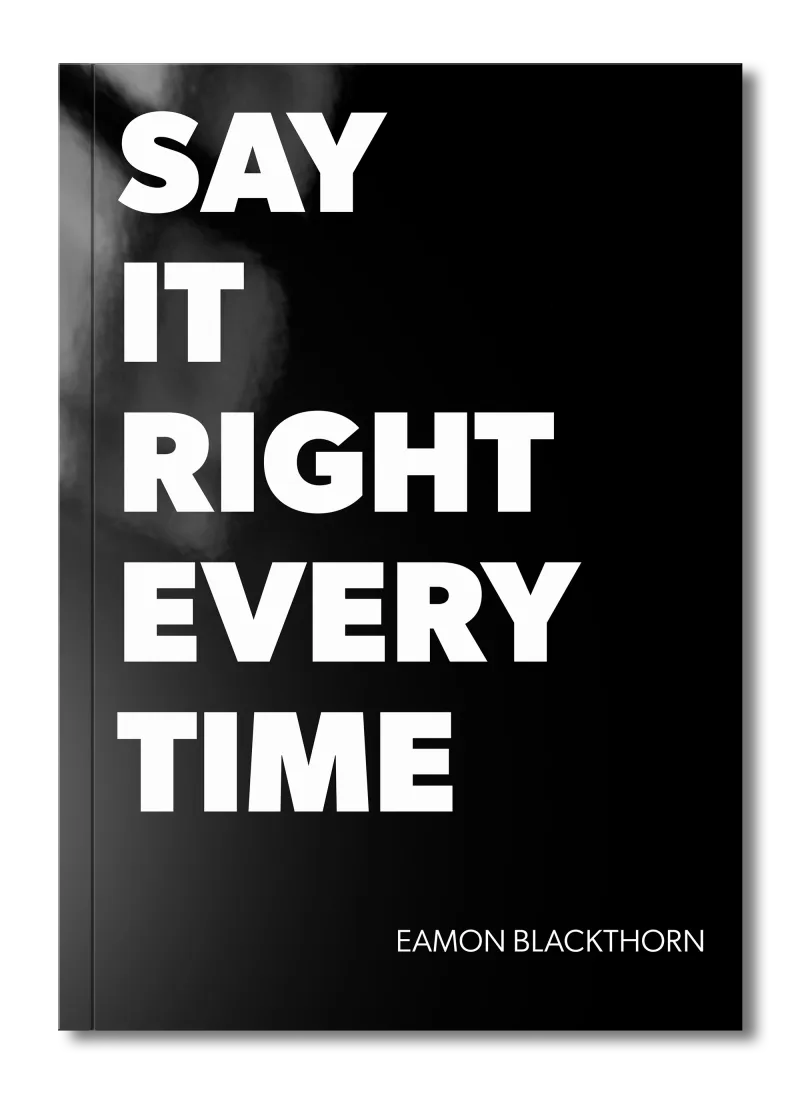
Stop rehearsing conversations you'll never have. Say It Right Every Time gives you 115 word-for-word scripts and 16 proven frameworks to speak with confidence in every conversation that matters.
The Foundation: What You Need Before You Start
Before you begin, there are three things that need to be clear.
A baseline of self-awareness. You need at least a rough sense of your current physical habits before you can change them. Record yourself speaking for two minutes on your phone. Watch it back once. You do not need a detailed analysis. You need to know whether you fold your arms, avoid the lens, or shift your weight constantly. One honest look is enough to start.
A low-stakes practice environment. Do not begin this work in a high-pressure meeting or a formal presentation. You need space to experiment without the cost of a real mistake. A one-on-one conversation with a trusted colleague, a short team check-in, or even a rehearsal in front of a mirror will give you the room to try, notice, and adjust.
One target per session. Trying to fix posture, eye contact, gesture, and facial expression all at once is how people make no progress on any of them. Choose one element to focus on in any given practice session. Let the rest run as normal. This is how physical habits actually change.
Get these right first. The steps that follow will not work without them.
Step 1: Ground Your Posture
Your posture is the foundation of everything else in confident body language, and it is the first thing people read when you enter a space.
Most people think about posture as a static thing: stand up straight and you are done. It is more than that. Grounded posture means your weight is distributed evenly, your feet are planted, and your upper body is open and settled. It signals that you belong in the space you are in.
Specifically:
- Stand with your feet roughly hip-width apart, weight balanced equally on both feet.
- Roll your shoulders back and down once, then let them settle there naturally without forcing them.
- Keep your chin level, not tilted up or tucked down.
- Relax your jaw. Tension in the jaw travels directly into your voice and your face.
- Before walking into any room or conversation, pause for three seconds and reset this position.
Here is what this looks like in practice. Before a team meeting, stop just outside the door. Take one breath, set your feet, roll your shoulders back. Walk in at that pace. Do not rush to sit down. Let yourself settle first. It takes five seconds and it changes the physical message you send before you have spoken a word.
Once your posture is reliable in low-stakes settings, every other element of physical expression builds on top of it. Without this base, everything else wobbles.
Step 2: Manage Stillness and Unnecessary Movement
Unnecessary movement is one of the fastest ways to signal anxiety, even when you feel none. Rocking, shifting weight, touching your face, clicking a pen, these habits leak tension into the room and pull attention away from your message.
Stillness is not rigidity. It is the absence of movement that serves no purpose. A still body reads as calm and in control. A moving body reads as uncertain, even when the words are clear.
To build deliberate stillness:
- Identify your personal nervous habit by watching your recorded footage from the baseline exercise.
- In your next low-stakes conversation, plant your feet and keep them there for the full duration.
- Rest your hands in a neutral position: loosely clasped in front of you, or resting open at your sides.
- When you feel the urge to touch your face or shift your stance, notice it and let it pass without acting on it.
Stillness is not something you can force all at once. Start by eliminating the single most distracting habit you identified in Step 1. Once that one is managed, the others become easier to address. Learning to work with stillness is also directly relevant when you are managing the dynamics in a discussion, where physical composure carries real authority.
Step 3: Use Gesture with Purpose
Gesture done well reinforces your message. Gesture done poorly distracts from it. The goal is not to gesture more, and it is not to gesture less. The goal is to gesture with intention.
Purposeful gesture means your hands move to illustrate or emphasise something specific, then return to a neutral position. The return is as important as the movement itself. Hands that never land anywhere make people uneasy.
Here is how to build purposeful gesture:
- Use open-palmed gestures when you want to signal honesty or invitation.
- Use a contained vertical gesture, palm facing inward, when you are making a specific point.
- Avoid pointing directly at people; use an open hand toward them instead.
- After each gesture, bring your hands back to a resting position before the next one.
Here is a practical example. You are explaining a two-part idea in a team debrief. As you describe the first part, you extend your left hand slightly, palm up. As you describe the second part, you extend your right hand the same way. Then you bring both hands together and rest them. The gesture maps your structure physically, and the listener follows it without thinking. That is gesture serving communication. When used well in feedback conversations, deliberate gesture also helps signal openness; you can read more about the relational side in How to Give Constructive Feedback Without Causing Tension.
Gesture is the element most people over-think. Keep it simple and keep it grounded.
Step 4: Hold Eye Contact with Intention
Eye contact is the most direct form of physical connection available to you. It signals that you are present, that you respect the person you are speaking with, and that you trust what you are saying. It is also the element most people either avoid entirely or overdo to the point of discomfort.
Comfortable, confident eye contact is not a stare. It is sustained attention with natural, brief breaks.
To build it:
- In one-on-one conversations, hold eye contact for roughly four to five seconds before looking away briefly, then returning.
- In group settings, move your gaze between individuals deliberately, giving each person a moment of direct connection.
- When listening, keep your gaze on the speaker. Breaking eye contact while someone else is talking signals distraction.
- If direct eye contact is difficult, focus on the area between the person's eyes and the bridge of their nose. From their perspective, it reads as direct contact.
Strong eye contact matters enormously in meetings where every participant needs to feel heard. When you look at the person speaking, you validate their presence physically, without saying a word.
Step 5: Align Your Facial Expression with Your Message
Your face is communicating constantly, whether you intend it to or not. A blank expression while delivering difficult news reads as cold. A smile during a serious moment reads as dismissive. Misalignment between your words and your expression erodes trust faster than almost anything else.
The repair is not to perform emotion. It is to remove the habits of suppression that create a gap between what you feel and what your face shows.
To align expression with message:
- Before important conversations, spend thirty seconds thinking about what you actually want the other person to feel. Let that intention settle before you speak.
- Practise reading your own expression in a mirror while saying neutral sentences. Notice where your default lands.
- When delivering positive recognition, let your face open: lift in the eyes, slight ease in the jaw. Do not manufacture a smile; remove the tension instead.
- When delivering difficult feedback, keep your expression steady and open, not hard or tight. Neutral is fine. Stony is not.
Here is what this looks like in a real moment. You are giving feedback to someone who has underperformed. You have prepared what you want to say. Before you begin, you pause, let your face relax, and make eye contact. Your expression is calm, direct, and open. The person across from you reads: this is serious, but it is not an attack. That physical signal shapes how they hear every word that follows. For leaders working on this, how leaders model effective feedback behaviour goes deeper on the connection between presence and influence.
Your face either opens the door or closes it. This is the step most beginners skip, and it shows.
Step 6: Use Space and Proximity Consciously
Where you position yourself physically in relation to others sends a message before you open your mouth. Standing too close signals aggression or pressure. Standing too far signals disengagement or insecurity. The right distance communicates respect and confidence simultaneously.
Professional proximity varies by context and culture, but a useful working rule is to keep roughly one arm's length of space in most conversational settings. Closer than that is for genuine personal connection. Further than that is for formal or large-group settings.
To use space well:
- When entering a room for a presentation or meeting, choose your position deliberately rather than defaulting to the nearest available spot.
- Avoid backing away when someone addresses you directly. Hold your ground while keeping your posture open.
- When approaching someone to speak privately, approach from the side rather than head-on where possible. It reduces the instinctive sense of confrontation.
- In seated conversations, lean forward slightly when you are listening actively. Lean back slightly when you are inviting the other person to speak. These micro-shifts are read unconsciously and shape the whole tone of the exchange.
Understanding how space and positioning affects the overall success of meetings is worth exploring as you get more deliberate about your physical presence in group settings.
Adapting This Process for Remote and Video Settings
Remote communication strips out half of your physical expression. The person on the other side of a video call cannot see your posture below the chest, your feet, or your full gesture range. What they can see is amplified: your face fills the screen, your upper body movement is magnified, and any tension in your jaw or shoulders is visible in detail.
Position your camera at eye level. A camera angled up from a laptop on a low desk creates an unflattering and unintentionally submissive angle. Raise the screen so the lens sits level with your eyes. This alone restores natural eye contact and gives your upper body appropriate framing.
Reduce background movement and distraction. In a physical room, stillness stands out as composed. On video, it is the default expectation. Any unnecessary movement, chair rocking, pen tapping, or constant repositioning reads louder on screen than in person. Ground yourself before the call starts.
Use gesture within the frame. Wide gestures disappear off-screen and look erratic on a small thumbnail. Keep gestures contained to shoulder width. Let them be deliberate and complete. The same principles of purpose and return apply; the space is simply smaller. Understanding emotional intelligence in feedback conversations is especially useful in remote settings where physical cues are limited and misreads are more common.
Check your own image before speaking. Most platforms allow you to see yourself. Use this. Not as vanity, but as calibration. Spend thirty seconds before the call noticing your posture, your facial expression, and your framing. Reset if needed.
The core process holds entirely in remote settings. Only the execution changes.
Common Mistakes to Avoid
Let me tell you about the mistakes I see most often. I have made most of them myself.
The mistake: Trying to change everything at once.
Why it happens: Awareness of multiple problems creates urgency to fix them all immediately.
What to do instead: Choose one element per practice session. Master it before layering the next one on top.
The mistake: Performing confidence rather than practising it.
Why it happens: People mimic what confident people look like rather than building the physical habits from the ground up.
What to do instead: Focus on removing tension and unnecessary movement first. Presence follows naturally; it cannot be pasted on from the outside.
The mistake: Holding eye contact so hard it becomes a stare.
Why it happens: Overcorrection after being told they avoid eye contact too much.
What to do instead: Use the four-to-five second rhythm with natural breaks. Sustained attention is not the same as unbroken eye contact.
The mistake: Forgetting the body in high-pressure moments.
Why it happens: Cognitive load takes over and physical awareness drops to zero when the stakes rise.
What to do instead: Build a pre-conversation physical reset into your routine: feet planted, shoulders back, one breath. Do it every time until it is automatic.
The mistake: Assuming stillness means absence of expression.
Why it happens: People conflate relaxing their gestures with going blank.
What to do instead: Stillness applies to unnecessary movement, not to facial expression or intentional gesture. Keep the face alive while the body settles.
These are not character flaws. They are gaps in the system. Fix the system.
Your Practical Checklist
Use this checklist before you begin and after each practice session.
- I have recorded myself speaking for at least two minutes and watched it back.
- I have identified my single most distracting physical habit from that recording.
- I have chosen one element of physical expression to focus on in this session.
- My feet are hip-width apart and my weight is balanced before I begin.
- My shoulders are back and relaxed, not forced or raised.
- I have identified a neutral resting position for my hands.
- I know what eye contact rhythm I am aiming for in this setting.
- I have thought briefly about the expression I want my face to carry into this conversation.
- I am practising in a low-stakes environment before taking this to a high-pressure one.
- I have a plan for what to do when I notice my nervous habit returning mid-conversation.
If you cannot check most of these, that is your starting point.
Summary and Next Steps
You now have a working process for confident body language that you can take into your next conversation, meeting, or presentation. You are no longer guessing; you have a sequence to follow.
- Grounded posture is the foundation. Everything else builds on it.
- Stillness is not rigidity; it is the absence of movement that serves no purpose.
- Gesture works best when it is intentional and returns to neutral after each use.
- Eye contact is a rhythm, not a stare; four to five seconds of sustained attention with natural breaks.
- Your face communicates whether you intend it to. Align it with your message by removing tension, not by performing emotion.
- Space and proximity are active tools. Use them deliberately rather than defaulting to habit.
- Remote settings amplify your upper body and face. The principles hold; the execution simply scales down.
If you want to take this further, start by reading about the role communication plays in meeting success, where physical presence shapes group outcomes in ways that go beyond the individual. If you manage others, the feedback models every manager should know will give you a structure to pair with the physical expression skills you are building here.
Body language is not a trick, and confident body language is not a costume you wear. It is the result of dozens of small physical habits, practised until they are natural.
Frequently Asked Questions (FAQ)
What is confident body language?
Confident body language is the deliberate use of posture, gesture, eye contact, and movement to communicate strength and presence without words. It is not about performing confidence but about removing the physical habits that signal uncertainty, so your body supports the message you intend to send.
How do you practice confident body language as a beginner?
Start with posture and stillness before working on gesture or eye contact. Practice in low-stakes settings first, such as one-on-one conversations or standing at your desk. Small, consistent changes in how you hold yourself build physical awareness over time.
Why is physical expression important in communication?
Physical expression accounts for a significant portion of how others interpret your message. Your posture, facial expression, and movement either reinforce or contradict your words. When your body and voice are aligned, people trust what you say more quickly.
Can you learn confident body language if you are naturally shy?
Yes. Confident body language is a skill, not a personality trait. Even naturally reserved people can learn to stand with an open stance, hold steady eye contact, and use purposeful gestures. It takes practice, but shyness does not prevent progress.
What are the most common mistakes with body language in professional settings?
The most common mistakes include crossing arms defensively, avoiding eye contact, shifting weight constantly, and using too many filler gestures. These habits signal nervousness or disengagement, even when you do not feel that way. Awareness and deliberate practice are the first repairs.
How long does it take to improve physical expression?
Most people notice a meaningful shift within two to four weeks of deliberate practice. The first changes come quickly: better posture, steadier eye contact, fewer nervous gestures. Deeper habits, like using gesture expressively or managing tension under pressure, take longer to master.