

What Happened
Gap's CEO recently made a strategic public move by tying the brand's cultural comeback narrative directly to specific business recovery targets. Rather than speaking in the vague language of "brand love" and "relevance," the CEO connected emotional positioning to measurable outcomes. This is a notable departure from the usual corporate soft-speak that plagues retail turnaround stories.
The Communication Angle
Can a leader talk about culture and credibility at the same time? Most executives pick one. They either go full poet (inspiring but empty) or full accountant (credible but cold). Gap's CEO just proved you can do both, and it is worth understanding exactly how.
The core technique at work here is called anchoring with proof. You make a bold claim, then you immediately attach a number to it. "We're culturally relevant again" means nothing on its own. Every struggling retailer says that. But when you follow it with specific targets, like revenue growth benchmarks or customer acquisition goals, you force your audience to evaluate the claim differently. Now it is a bet, not a bumper sticker. That is a fundamentally stronger communication position.
Here is why this matters so much in leadership communication. Audiences, whether they are investors, employees, or journalists, have a built-in skepticism filter. Vague optimism triggers it immediately. Concrete goals short-circuit it. When a CEO says "we are back," everyone rolls their eyes. When a CEO says "here is what back looks like and here is the timeline," people start doing the math. You have shifted the conversation from belief to evaluation. That is exactly where a turnaround leader wants to be.
The second technique Gap's CEO used is narrative sequencing. Cultural relevance was the opening frame, and hard goals were the payoff. This order matters. If you lead with the numbers, you sound defensive. You sound like you are managing expectations downward. But if you open with the story of why the brand matters, then land the targets, those numbers feel like the logical conclusion of something real. The sequence does the persuasion work.
What most executives get wrong is they treat the story and the strategy as two separate presentations. One for the town hall, one for the earnings call. Gap's CEO put them in the same sentence. That is harder than it sounds, and it is the right call every time.
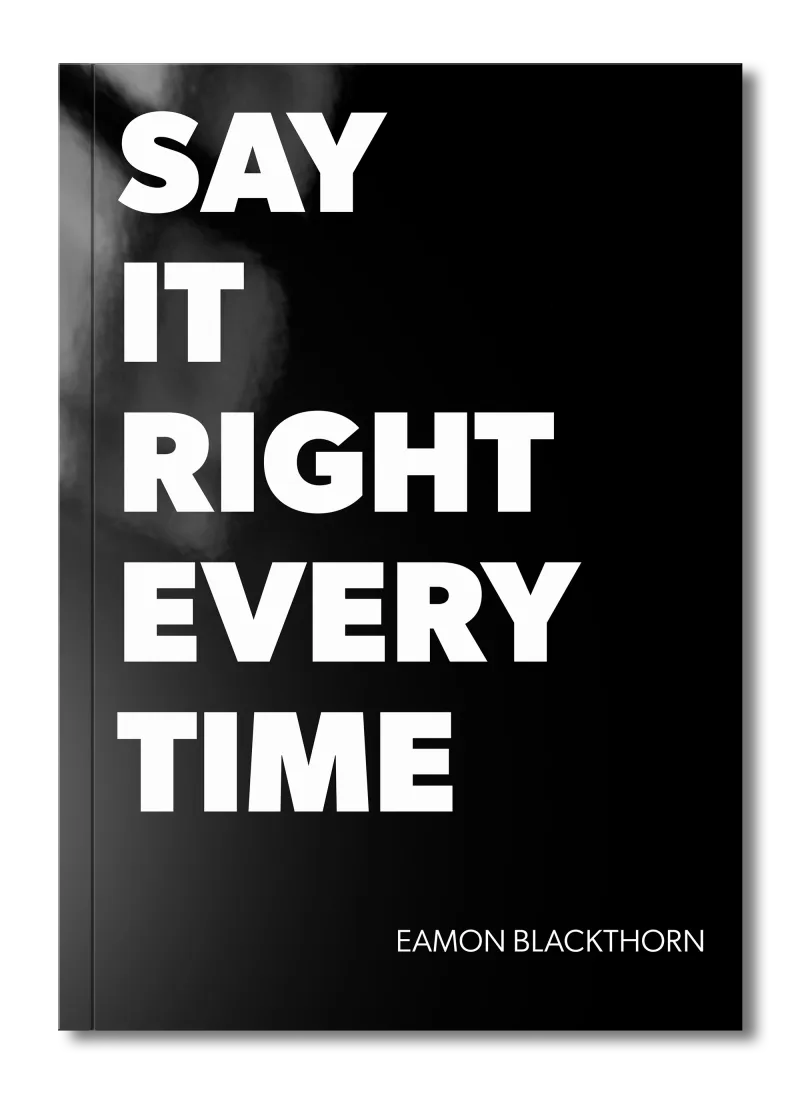
This is exactly the kind of scenario I break down in Say It Right Every Time. The chapter on speaking with authority covers the specific structure of how to pair a big claim with hard evidence without sounding like you are reading from a press release. Most people think authority comes from confidence. It does not. It comes from the ratio of claims to proof. Gap's CEO got that ratio right. You can too, and I give you the exact formula for building it in any context, from a board room to a one-on-one conversation with a skeptical direct report.
Never Be Lost
for Words Again
Get word‑for‑word scripts for the conversations that shape your life, from job interviews and negotiations to difficult talks with family and partners, so you always know exactly what to say and how to say it.
Never Be Lost
for Words Again
Get word‑for‑word scripts for the conversations that shape your life, from job interviews and negotiations to difficult talks with family and partners, so you always know exactly what to say and how to say it.
Key Takeaway
Before your next leadership update, whether it is a team meeting or a public statement, write down your one emotional claim and your one concrete proof point. Then practice saying them back to back in two sentences. If you cannot connect them naturally, you are not ready to deliver the message. The connection is the message.