

What Happened
Executives are increasingly finding that a traditional CV falls short when competing for top roles or board seats. A list of job titles and accomplishments tells hiring committees where you have been. It does not tell them how you think, how you decide under pressure, or what kind of culture you build around you. A new trend is pushing senior leaders to articulate their leadership philosophy in formats beyond the résumé.
The Communication Angle
Here is the contrast that matters: the executive who hands over a polished CV versus the executive who shows up with a clear, spoken point of view about how they lead. One is a document. The other is a person. Hiring committees and boards are not just filling a slot. They are betting on a human being. The candidate who can only gesture at their past has already lost ground to the one who can explain their thinking out loud.
What does "articulating your leadership philosophy" actually look like in practice? The weak version sounds like this: "I believe in people-first leadership and collaborative decision-making." That sentence means nothing. It is the communication equivalent of a stock photo. Every executive says some version of it. The strong version is specific. It sounds like: "When I inherited a team that had missed targets for three straight quarters, I stopped the strategy meetings entirely for two weeks and just listened. Here is what I found, and here is what I changed." That is a philosophy in action. That is a story that proves a point of view.
The comparison breaks down like this. The CV-dependent executive communicates through credentials. The philosophy-forward executive communicates through evidence and specificity. Credentials are passive. They happened to you. A philosophy is active. It is something you chose, tested, and refined. One tells a committee what you have done. The other tells them who you are and what you will do next. Boards and senior hiring teams make decisions based on trust, not transcripts. Trust is built through language, not bullet points.
The fix is not complicated, but most executives resist it because it feels exposed. You have to be willing to take a clear position and defend it. Not "I adapt my style to the situation" (which is another way of saying nothing). Instead: "I believe the first job of a leader in a crisis is to slow down the room, not speed it up." That is a position. It is arguable. Some people will disagree. That is the point. A philosophy without edges is not a philosophy. It is a press release.
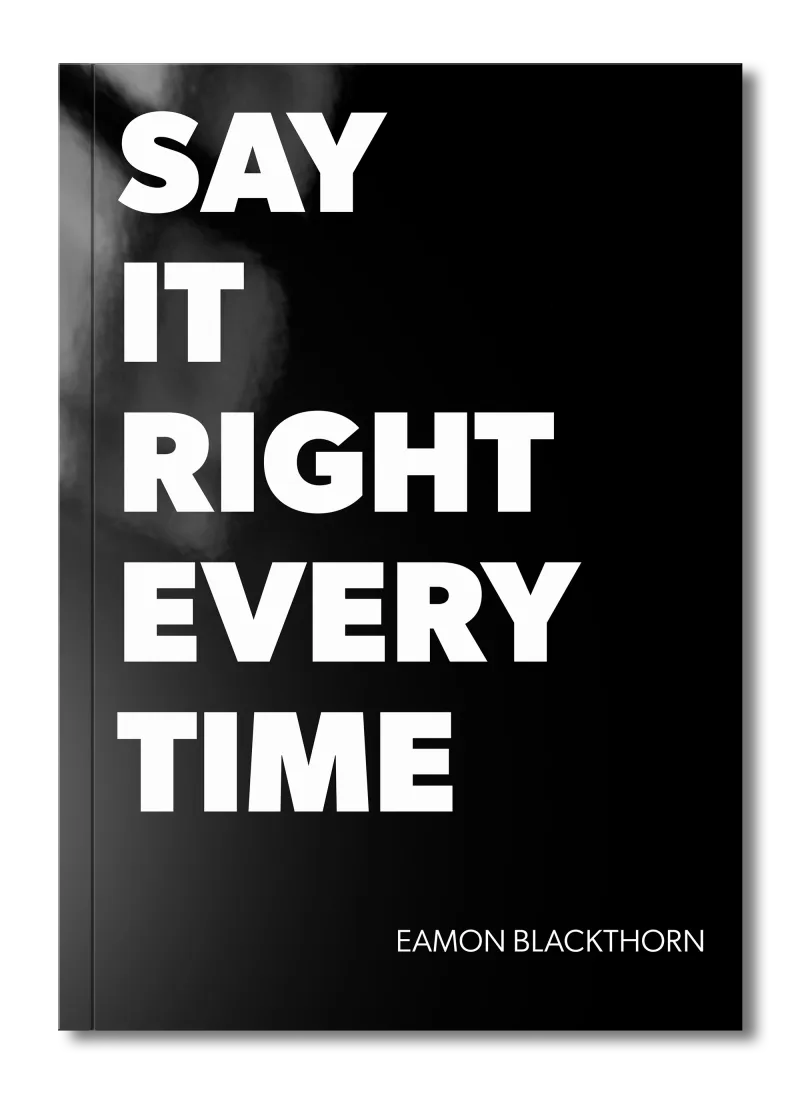
This is exactly the kind of scenario I break down in Say It Right Every Time. The chapter on high-stakes self-presentation gives you a framework for translating your experience into a clear, defensible point of view that lands with the people who matter most. The difference between a candidate who impresses and one who is forgotten almost always comes down to specificity and the willingness to say something that could actually be disagreed with.
Never Be Lost
for Words Again
Get word‑for‑word scripts for the conversations that shape your life, from job interviews and negotiations to difficult talks with family and partners, so you always know exactly what to say and how to say it.
Never Be Lost
for Words Again
Get word‑for‑word scripts for the conversations that shape your life, from job interviews and negotiations to difficult talks with family and partners, so you always know exactly what to say and how to say it.
Key Takeaway
Before your next interview, board presentation, or senior networking conversation, write down one leadership decision you made that you would make the same way again even knowing it was unpopular. Then practice saying it out loud in two sentences. That is the beginning of a leadership philosophy that actually communicates something.