
In Short
You can customize confrontation scripts for toxic traits so they reflect your voice and produce real results, not just uncomfortable silence.
- Identify the exact toxic behavior before you touch any script.
- Rewrite every phrase that does not sound like you.
- Rehearse aloud until the words feel natural under pressure.
Confrontation scripts for toxic traits are structured, word-for-word frameworks designed to help you address harmful behavioral patterns in another person directly, clearly, and without escalation. They provide language scaffolding you adapt to your own voice and the specific situation you are facing.
A manager I know spent three weeks building the courage to speak to a colleague whose constant undermining had fractured the team. She found a script online. She practiced it. She walked into the room and delivered it almost word for word. The colleague's response was simple: "That sounds like something you read somewhere." And just like that, the conversation was over. The behavior continued for another four months.
That story is not unusual. When you confront someone with toxic traits using language that does not belong to you, they hear the gap. People who operate through manipulation, deflection, and blame are often highly attuned to authenticity. The moment your words feel rehearsed in the wrong way, scripted in the hollow sense, you lose standing. The confrontation scripts you use must start as frameworks and finish as yours.
Here is what this article gives you: a clear process for taking any confrontation script, stripping out what does not fit, rebuilding it in your voice, and delivering it with enough preparation that you do not fall apart when the other person pushes back.
Why Confronting Toxic Traits Feels Different From Other Hard Conversations
Most difficult conversations involve two people with different preferences or priorities. Confronting toxic traits is something else. You are addressing a pattern of behavior, often repeated over time, that has caused real harm. And the person you are addressing may not recognize themselves in your description at all.
Toxic behaviors, whether chronic blame-shifting, passive aggression, manipulation, or persistent boundary violations, rarely feel toxic to the person exhibiting them. That disconnect is the source of the difficulty. You come prepared with observations; they arrive prepared with justifications. If your language sounds borrowed or imprecise, you give them the opening they need.
There is also the personal cost to consider. If you have been on the receiving end of these behaviors for any length of time, you carry frustration, self-doubt, and sometimes genuine fear into the room. A script that does not match your internal state will crack the moment any emotion surfaces. That is not a failure of nerve. That is a mismatch between the tool and the person holding it.
"The Conversation You're Avoiding Is the One You Need to Have."
"The Conversation You're Avoiding
Is the One You Need to Have."
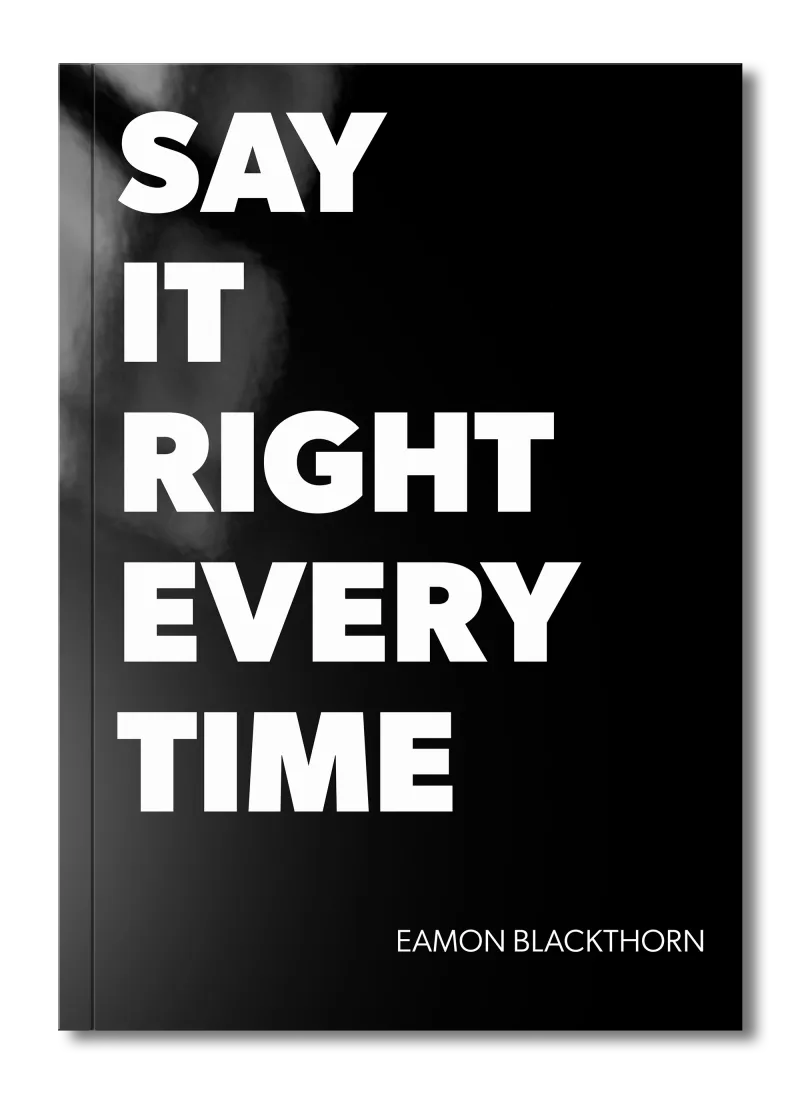
Stop rehearsing conversations you'll never have. Say It Right Every Time gives you 115 word-for-word scripts and 16 proven frameworks to speak with confidence in every conversation that matters.
What Needs to Be True Before You Write a Single Word
The script comes later. Before you touch any language, two things must be in place.
First, you need specific observations, not general feelings. "You are always negative" will not hold up. "In the last three team meetings, you interrupted four colleagues and dismissed two proposals without offering an alternative" will. Toxic behaviors thrive in vagueness. Specificity is what makes a confrontation real rather than personal. If you cannot name three concrete examples of the behavior, you are not ready.
Second, you need clarity on what you want to happen after this conversation. Not what you want the person to feel. Not what you want them to admit. What you want them to do differently, specifically, going forward. That outcome shapes every word you write into your script. Without it, the conversation becomes a confrontation without a destination.
How to Customize Confrontation Scripts for Toxic Traits Step by Step
Find a script that addresses the specific behavior pattern, not the general topic.
The further the script is from your actual situation, the more rewriting you face. If the toxic trait you are addressing is blame displacement, find a script built for that pattern. A script for "giving feedback" will not carry the weight you need. If you are dealing with passive-aggressive behavior that is quietly eroding your team, this guide on addressing passive-aggressive behavior gives you a stronger starting point than a general confrontation framework.
Read the script aloud and mark every phrase that is not your language.
Do this before you change a single word. Read it the way you would in the actual conversation. Every time a phrase makes you hesitate, circle it. Common culprits are formal constructions ("I would like to bring to your attention"), corporate softening ("moving forward"), and vague references ("your behavior lately"). These phrases are not wrong in themselves. They are wrong if they are not how you speak.
Rewrite each marked phrase in your own vocabulary.
Take one phrase at a time. Ask yourself: how would I say this to someone I trust, if I were being direct? Then write that version. If the script says "I have noticed some concerning patterns," and you would naturally say "Something has been bothering me and I need to be straight with you," use your version. The underlying structure stays; the words become yours.
Here is a practical example. A common script for addressing a colleague who dismisses others' contributions might read: "I want to raise something I have observed in our team meetings. When others share ideas, there have been instances where the response has not supported a collaborative environment."
Your version might be: "I need to talk to you about something I have been watching happen in our meetings. When someone puts an idea on the table, the way you respond is shutting the conversation down. I have seen it happen three times this month."
Both address the same behavior. Only one sounds like a person.
Build your opening sentence with care, then let the rest follow.
In a confrontation involving toxic traits, your opening sentence does the hardest work. It sets the tone, establishes that you are serious, and signals to the other person that this is not a casual complaint. Write three or four different versions of your opening. Say each one aloud. Choose the one that sounds most like you under pressure, not the most polished version on paper.
A strong opening is direct, specific, and calm. "I need to talk to you about something that has been happening, and I want to be clear about what I am seeing" is a better start than "I feel that sometimes the team dynamic could be improved." One signals confidence. The other signals hesitation.
Script your response to the three most likely forms of pushback.
This is where most people fail. They prepare a solid opening and then have nothing when the other person deflects, minimizes, or attacks. Toxic behavior in a confrontation often looks like one of three things: denial ("That is not what happened"), reversal ("You are the one who always..."), or victimhood ("I cannot believe you are coming after me like this").
Write a one or two sentence response for each. Keep them calm and anchored to your specific examples. For denial: "I understand you see it differently. What I can speak to is what I observed directly, and I have three specific examples." For reversal: "I am happy to talk about my behavior separately. Right now I need us to stay on this." For victimhood: "I am not coming after you. I am raising something that needs to change."
For anyone navigating a pattern where a colleague is systematically undermining the group, these scripts for addressing team members who undermine group cohesion offer strong pushback language you can adapt using the same process.
Replace abstract language with behavioral language throughout.
This is the most important single edit you make. Toxic traits are behavioral patterns. Your script must describe behaviors, not character. Every time you have written something like "your attitude," "the way you are," or "your negativity," replace it with what the person actually did. "Your attitude in meetings" becomes "when you respond to a colleague's idea by talking over them." "Your negativity" becomes "when you point out obstacles without offering alternatives."
This matters for two reasons. It keeps you legally and relationally grounded. And it removes the person's easiest escape route, which is to argue about who they are rather than what they did. I cover this principle in depth in Say It Right Every Time, where the S.B.I. Method, built on Situation, Behavior, and Impact, gives you a reliable structure for exactly this kind of language precision.
Rehearse standing up, not sitting at a desk.
This sounds like a small thing. It is not. The physical state you rehearse in shapes the physical state you arrive in. Stand. Speak at the pace you would use in the actual conversation. If you stumble, restart from that sentence, not from the beginning. You are not memorizing a monologue. You are making the words available to you under pressure. There is a significant difference.
After five or six full run-throughs, your script stops feeling like a script. That is what you are working toward.
Adapting Your Script for Remote Confrontations
Confronting toxic traits over video is harder in some ways and easier in others. The harder part: you lose physical presence, and toxic personalities are skilled at using the distance of a screen to deflect or disconnect. The easier part: much toxic remote behavior leaves a trail. Messages, threads, and recordings give you documented examples you can reference directly, which strengthens your position considerably.
When you adapt a script for a remote confrontation, slow your delivery. Pause longer between your key points than you would in person. The absence of body language means your words carry all the weight, and rushed language reads as anxiety. State what you are going to say before you say it: "I want to share three specific things I have observed, and then I want to hear your response." That structure keeps a remote conversation from becoming a talking-over-each-other situation.
If the toxic behavior has been showing up in written communication, and you are dealing with a pattern where someone is isolating themselves or others through their behavior, this resource on telling a team member their behavior is isolating them from the group offers scripts designed for exactly that scenario.
What People Get Wrong When They Try This
The mistake: Using a script to avoid the discomfort rather than to prepare for it.
Why it happens: People hope the script will do the emotional work for them, so they do not have to feel the difficulty of the conversation.
What to do instead: The script is a structure, not a shield. You still have to be present, responsive, and willing to sit in the discomfort. Prepare emotionally, not just linguistically.
The mistake: Over-softening the language until the message disappears.
Why it happens: The fear of seeming aggressive leads people to hedge every statement until there is no statement left.
What to do instead: Keep the specific behavior description intact. You can be warm in your tone without being vague in your content. Softening the delivery is fine. Softening the message is not.
The mistake: Treating the first conversation as the last one.
Why it happens: People want the discomfort to be over, so they frame the confrontation as a single definitive moment.
What to do instead: Build a follow-up expectation into your script. "I would like us to revisit this in two weeks" is not weakness; it is accountability. Starting a difficult conversation that addresses a team-level problem requires the same follow-through planning.
The mistake: Skipping the preparation to seem spontaneous.
Why it happens: Some people believe that rehearsed equals inauthentic.
What to do instead: The preparation is what makes the authenticity possible. You cannot think clearly and speak clearly simultaneously when your nervous system is under threat. Preparation removes that burden. See Word-for-Word Scripts for Giving Constructive Feedback at Work for examples of how scripted language becomes natural language through rehearsal.
Your Pre-Confrontation Script Checklist
Use this before every confrontation involving toxic behavior patterns.
Preparation:
- I can name at least three specific, observable examples of the behavior.
- I know what outcome I want from this conversation.
- I have identified a private setting and a time with no immediate pressure on either party.
- My emotional state is regulated. I am not going in hot.
Script quality:
- Every phrase sounds like something I would naturally say.
- I have used behavioral language throughout, not character judgments.
- My opening sentence is direct, specific, and calm.
- I have scripted responses to denial, reversal, and victimhood.
Delivery:
- I have rehearsed aloud at least five times.
- I know where I will pause.
- I have a follow-up plan written into the close of my script.
If even one box is unchecked, do not go in yet. The conversation will not be better for going in underprepared. It will simply be over sooner.
When the broader team dynamic is at risk, how to use "I" statements to prevent blame cycles and how to deliver a neutral problem statement that stops conflict early are both worth reading before you finalize your script. They will sharpen your language considerably.
The Conversation You Owe Yourself and Them
Here is the truth of it. The reason confrontation scripts for toxic behavior patterns fail is almost never the words. It is the gap between the words and the person delivering them. Close that gap, and you close the exit route that toxic behavior depends on.
You earn the right to be heard by showing up prepared, specific, and unmistakably yourself. That combination is harder to dismiss than any template ever written. Take the script, make it yours, rehearse until the seams disappear, and then go have the conversation you have been putting off. The Say It Right Every Time framework gives you the full architecture if you need it. The words, in the end, have to be your own.
Frequently Asked Questions (FAQ)
What are confrontation scripts for toxic traits?
Confrontation scripts for toxic traits are prepared word-for-word phrases that help you address harmful behavioral patterns directly and clearly. They give you a starting point so you do not freeze or escalate in the moment. The goal is to adapt them until they sound like your natural voice.
How do you customize a confrontation script so it sounds natural?
You customize a confrontation script by reading it aloud, identifying every phrase that does not match your speech patterns, and rewriting those phrases word by word. Replace formal language with your own vocabulary, adjust the pace to match how you normally speak, and rehearse until no sentence feels borrowed.
Why do generic confrontation scripts fail with toxic people?
Generic scripts fail because toxic behaviors are specific, and a script written for a vague situation will not address the exact pattern you are facing. The person you are confronting will also sense inauthenticity, which gives them room to dismiss your concern rather than engage with it.
What should you do before using a confrontation script on toxic traits?
Before using any confrontation script, document the specific behaviors you have observed, choose a private setting, and regulate your own emotional state. You need a clear outcome in mind, not just a list of grievances. Preparation determines whether the conversation moves toward resolution or conflict.
How do confrontation scripts differ for remote versus in-person toxic behavior?
Remote toxic behavior often leaves a written record, which means you can reference specific messages or patterns directly in your script. The core structure stays the same, but your delivery adapts: slower pacing, longer pauses, and clearer language to compensate for the absence of body language cues.
What is the biggest mistake people make when confronting toxic traits?
The biggest mistake is treating the confrontation as a single event rather than a process. People prepare a strong opening, then have no plan for what happens when the other person gets defensive or deflects. A complete script anticipates resistance and includes a calm, prepared response to the most likely pushback.