
In Short
Patient hearing scripts are only useful when they sound like you. A script that feels borrowed will break down the moment someone pushes back or raises their voice.
- Rewrite the vocabulary to match how you actually speak.
- Practice aloud until the phrases no longer require conscious retrieval.
- Adapt the structure for the specific person and setting you are facing.
Patient hearing scripts are structured listening phrases designed to help you stay present, calm, and non-reactive during difficult conversations. They give you a prepared response framework so that emotional pressure does not override your ability to truly hear the other person.
A colleague had been building tension with her team for six months. She read everything she could find on active listening, wrote down three or four scripts from a communication workshop, and walked into the conversation ready. Forty seconds in, her team member said something unexpected and sharp. She looked down at her notes. The room noticed. The conversation collapsed into defensiveness before it had a chance. The scripts were fine. The problem was they were not hers. She had memorised words she had never actually spoken before, in a moment that demanded she sound completely natural.
That is the specific difficulty of patient hearing scripts. They work beautifully on paper. Under pressure, with a difficult person across the table, they can feel like a costume you threw on in the car park.
By the end of this article, you will have a working method for taking any patient hearing script and making it genuinely yours, so it holds under stress, sounds like you, and actually does the job it was built to do.
Why Patient Hearing Scripts Break Down in Real Conversations
The failure is almost never about the script itself. It is about the gap between reading something and owning it.
When you use language that does not live in your normal speech, your brain has to retrieve it consciously. That retrieval takes up the same mental space you need for actually listening. So you end up half-listening to the person in front of you while half-monitoring your own next line. That is not patient hearing. That is performance anxiety with a clipboard.
There is a second problem. Difficult people are perceptive. They hear the seams in borrowed language. When your word choice shifts register mid-conversation, something in the other person registers that shift as inauthentic. Trust drops. Defensiveness rises. The script that was meant to de-escalate actually makes things worse.
I spent years trying to give people scripts verbatim, watching them fail in the field, and wondering why. The answer was always the same: the script was not adjusted to the person using it. That gap between knowing and doing is something I cover in depth in Say It Right Every Time, because it is the most common reason good communication advice fails in practice.
"The Conversation You're Avoiding Is the One You Need to Have."
"The Conversation You're Avoiding
Is the One You Need to Have."
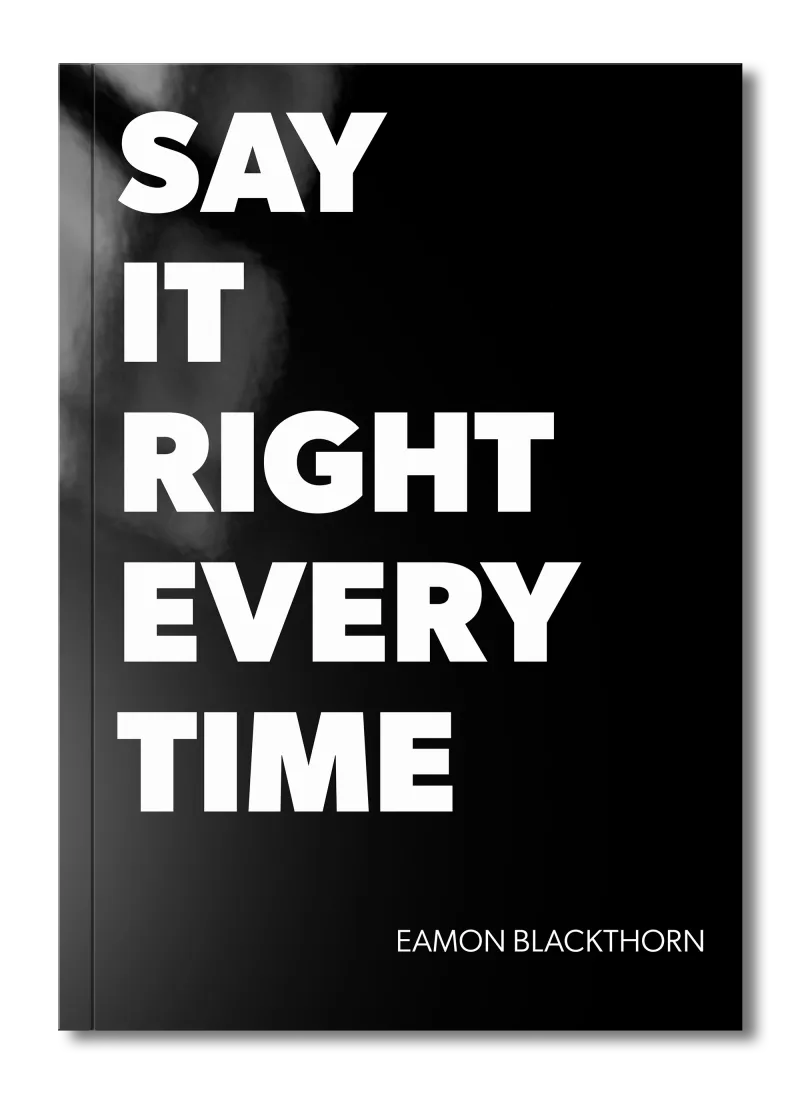
Stop rehearsing conversations you'll never have. Say It Right Every Time gives you 115 word-for-word scripts and 16 proven frameworks to speak with confidence in every conversation that matters.
What Needs to Be True Before You Begin
Before you touch a single word of your patient hearing script, two things need to be in place.
First, you need to understand what the script is actually doing, structurally. Patient hearing scripts are not magic phrases. Each line serves a purpose: acknowledging emotion, inviting elaboration, demonstrating that you followed the content, or signalling that you are not about to react. If you do not know why a line is there, you will cut the wrong parts when you personalise it.
Second, you need a genuine intention to listen, not just to appear to listen. No script survives contact with a difficult person if your underlying goal is to get through the conversation rather than understand it. The script is a tool. You are the craftsman. A chisel in hands that do not want to carve will not produce a clean line.
If you are walking into a conversation ready to defend your position the moment the other person pauses, stop. Come back to this when you have decided you actually want to understand what they are experiencing. That readiness is what makes starting a difficult conversation possible in the first place.
How to Make Patient Hearing Scripts Sound Like You
Work through these steps before any conversation where you plan to use a structured listening approach.
Read the original script aloud, alone. Do not read it in your head. Speak it. Listen for words that snag, phrases that feel stiff, or sentences that are three times longer than you would naturally speak. Mark every one. These are the places the script will crack under pressure.
Replace formal vocabulary with your own register. If the script says "I want to ensure I have understood your perspective accurately," and you would never say "ensure" in a real conversation, change it. "Let me make sure I have this right" carries the same meaning. Write your version beside the original. The structure stays. The vocabulary becomes yours. This single step removes most of the awkwardness people experience with patient hearing scripts.
Shorten the lines that feel like speeches. Scripts written for training manuals are often written to demonstrate comprehensiveness. You do not need to demonstrate comprehensiveness. You need to be heard as genuine. "That sounds frustrating" lands harder than "I can appreciate that this situation has been a source of considerable frustration for you." Cut the scaffolding. Keep the intention.
Add one phrase that is distinctly your own. Every experienced communicator has a natural bridge phrase they use when they want to show they are thinking carefully. Mine is a simple pause followed by "Here is what I am hearing." Yours might be different. Find it, or invent it, and plant it somewhere in the script. It is your signature in the conversation, and it signals authenticity to the other person.
Write a short clarifying question in your own words. Patient hearing depends on your ability to invite the other person to go deeper. The question "Can you tell me more about that?" works fine. But if you naturally say "What was the hardest part of that for you?" or "Where did that start for you?", use that instead. The question should feel like something you would ask a friend, not a subject you are cross-examining. Thoughtful clarifying questions are also one of the most reliable tools for preventing blame cycles from taking hold.
Practice aloud until the script disappears. This is the step most people skip. They read the revised script a few times in their head and consider it done. That is not preparation. That is familiarity. You need to speak the phrases enough times that they stop requiring conscious retrieval. Ten repetitions aloud, across two or three sessions, is a reasonable minimum. When you can say the phrases while thinking about something else, they are ready to use.
Do one dry run with a low-stakes listener. Ask a trusted colleague or a friend to play the difficult person, even loosely. Speak your adapted script. Notice where you hesitate, where you fall back into the formal original, and where you genuinely sound like yourself. Adjust those spots. This rehearsal is the clearest signal of whether you are ready. For a complete framework on preparing phrases before high-pressure conversations, Say It Right Every Time lays out a step-by-step process that takes the guesswork out of preparation.
Adapting Your Script for Remote and Video Conversations
The process above holds for in-person conversations. Remote settings shift the dynamics enough that your patient hearing scripts need one extra layer of adjustment.
On a video call, you lose the small physical signals that make patient hearing visible: the forward lean, the maintained eye contact that comes from a shared room, the slight nod that tells someone you are following. Your verbal responses carry the entire weight. That means your acknowledgment phrases need to be more deliberate and slightly more explicit than they would be face to face.
Where you might nod in a room, you say the person's name and a short acknowledgment. Where you might lean forward, you say "I want to make sure I caught all of that." Slow your pace by about ten percent. Silence feels longer on a video call, so do not rush to fill it. Give the other person room to finish a thought fully before you respond.
Also check for the obvious: mute yourself when you are not speaking. Background noise is the enemy of patient hearing on a call, and if the other person suspects you are distracted, the trust the script is trying to build evaporates immediately. For guidance on how communication choices affect team dynamics more broadly, it is worth understanding how remote miscommunication compounds over time.
Where People Go Wrong with Patient Hearing Scripts
Three specific mistakes come up repeatedly. Each one has a direct fix.
The mistake: Keeping the script's original vocabulary because changing it feels like cheating.
Why it happens: People assume the exact wording is what makes the script work.
What to do instead: Understand that the structure carries the function, not the specific words. The goal is for the other person to feel heard. Any vocabulary that genuinely achieves that goal is correct.
The mistake: Running through the script in your head while the other person is still speaking.
Why it happens: Anxiety about what to say next pulls attention away from listening.
What to do instead: Trust the preparation you have already done. The script is loaded. Your only job during the other person's speaking time is to actually listen. Your next phrase will be there when you need it.
The mistake: Using the script as a full conversation plan rather than a structural anchor.
Why it happens: People want certainty in uncertain conversations, so they over-script.
What to do instead: Prepare the acknowledgment phrases and the clarifying question. Leave the rest of the conversation genuinely open. Patient hearing cannot be fully scripted because you do not know yet what the other person is going to say. The script gives you a stable place to land, not a road to follow.
This same principle applies when you are delivering feedback or working through conflict resolution: a structure helps you stay on ground, but the conversation itself must breathe.
Your Pre-Conversation Script Readiness Check
Before you walk into a conversation with a difficult person, run through this checklist. It takes less than five minutes and it is the clearest test of whether your patient hearing script is genuinely ready to use.
- Can you say every phrase aloud without looking at your notes?
- Does every sentence sound like something you would say in an ordinary conversation?
- Have you replaced any phrase that felt stiff, formal, or borrowed?
- Do you have one clarifying question ready in your own words?
- Have you identified one phrase that is distinctly yours, not from the original script?
- Have you practiced aloud, not just read the script in your head?
- Do you know why each line is in the script? What job is it doing?
- Have you decided, genuinely, that your goal is to understand rather than to win?
If you can say yes to all eight, the script is ready. If two or three answers are uncertain, give it one more practice session before the conversation. Skipping preparation is the first step toward needing to repair the relationship afterward, which is a harder conversation than the one you avoided.
The Difference Between a Script You Know and a Script You Own
Here is the truth of it. A script you know is a net. A script you own is a second nature.
When a conversation turns difficult, and a difficult person says something sharp or surprising, a script you only know will be gone in an instant. Your brain floods, your retrieval fails, and you fall back on instinct. For most of us, instinct under pressure means defensiveness.
A script you own stays with you because it has been spoken out of your mouth enough times that it is no longer separate from you. You do not reach for it. It is simply the way you respond. That is the standard worth preparing to. That is what patience, as a skill, actually requires.
The work of personalising patient hearing scripts is not a shortcut. It is the actual work. Take the time to make the language yours, practice it until it disappears into your natural voice, and walk into that conversation knowing you have prepared properly. Patient hearing scripts only earn their keep when they sound nothing like a communication manual and everything like you.
Frequently Asked Questions (FAQ)
What are patient hearing scripts?
Patient hearing scripts are pre-prepared phrases that help you listen and respond to a difficult person without reacting defensively. They give you a structure to follow when emotions run high, so you can stay calm, ask the right questions, and make the other person feel genuinely heard.
How do you customize patient hearing scripts to sound natural?
Start by reading the script aloud and noticing which words feel foreign in your mouth. Replace formal phrasing with words you actually use in conversation. Then practice the adjusted version until it no longer requires conscious thought to deliver under pressure.
Why do patient hearing scripts feel awkward to use?
Scripts feel awkward when they are written in someone else's register. If the vocabulary is more formal than your everyday speech, your delivery will sound stilted. The fix is not to abandon the script but to rewrite its language while keeping its structure and purpose intact.
Can patient hearing scripts work in remote or video call settings?
Yes, but they need adjustment. In remote settings you lose body language cues, so your verbal responses must carry more weight. Slow down slightly, use the person's name more deliberately, and rely on explicit acknowledgment phrases rather than nods or expressions the camera may not catch.
How long does it take to internalize patient hearing scripts?
Most people need ten to fifteen deliberate practice repetitions before a script stops feeling scripted. Practice aloud, not just in your head. Low-stakes conversations with a colleague or trusted friend are the best rehearsal ground before you use the script with a genuinely difficult person.
What is the biggest mistake people make when using patient hearing scripts?
The most common mistake is running through the script in your mind while the other person is still talking. That is not patient hearing at all. The script is preparation, not a crutch. Learn it well enough that your full attention can stay on the speaker, not on your next line.