
In Short
Patient hearing skills decide whether a distorted conversation spirals or steadies.
- When someone twists your words, defending yourself in the moment almost always makes things worse.
- The skill is staying grounded long enough to correct the record calmly and precisely.
- A clear, repeatable process gives you the strength to do this even when it feels impossible.
Patient hearing skills are the deliberate practice of listening fully and responding with precision when someone misrepresents what you said mid-conversation. The skill requires you to pause, track what was actually said, and restore accuracy without escalating the exchange.
You said something clear. You meant it plainly. Then the other person looked at you and replied to a version of your words that bore almost no resemblance to what you said. Not a misunderstanding, exactly. Something sharper than that. A twist. And before you could gather yourself, you were defending a position you never took, justifying an intention you never had, and losing ground in a conversation you thought you had a grip on.
Practicing patient hearing in that moment is one of the hardest things in communication. Not because the concept is complicated, but because the instinct to correct, defend, and push back surges so fast that your response is already out before your thinking catches up. Most people find that the harder they fight the distortion in real time, the worse it gets.
This guide gives you a working process. Not theory. A sequence you can prepare, practise, and apply the next time it happens.
Why Word Distortion Feels Like Such a Personal Attack
When someone twists your words, it does not feel like a communication problem. It feels like an assault on your character. That is the first thing worth understanding.
The brain registers misrepresentation as a threat, not a misunderstanding. Your body responds accordingly: heart rate climbs, thinking narrows, and the impulse to correct becomes almost overwhelming. The problem is that correction delivered in that state almost always sounds like aggression, and aggression invites more distortion.
There is also something disorienting about having your own words returned to you in a broken form. You know what you said. You know what you meant. But now you are being asked to defend a statement you did not make, and any denial sounds suspicious. It is a trap with no obvious exit.
I have sat across tables from people who did this habitually. Some did it deliberately, as a tactic. Others did it because their own defences were so high that they genuinely heard everything as an attack. The process for handling both is similar, and it starts well before you open your mouth.
"The Conversation You're Avoiding Is the One You Need to Have."
"The Conversation You're Avoiding
Is the One You Need to Have."
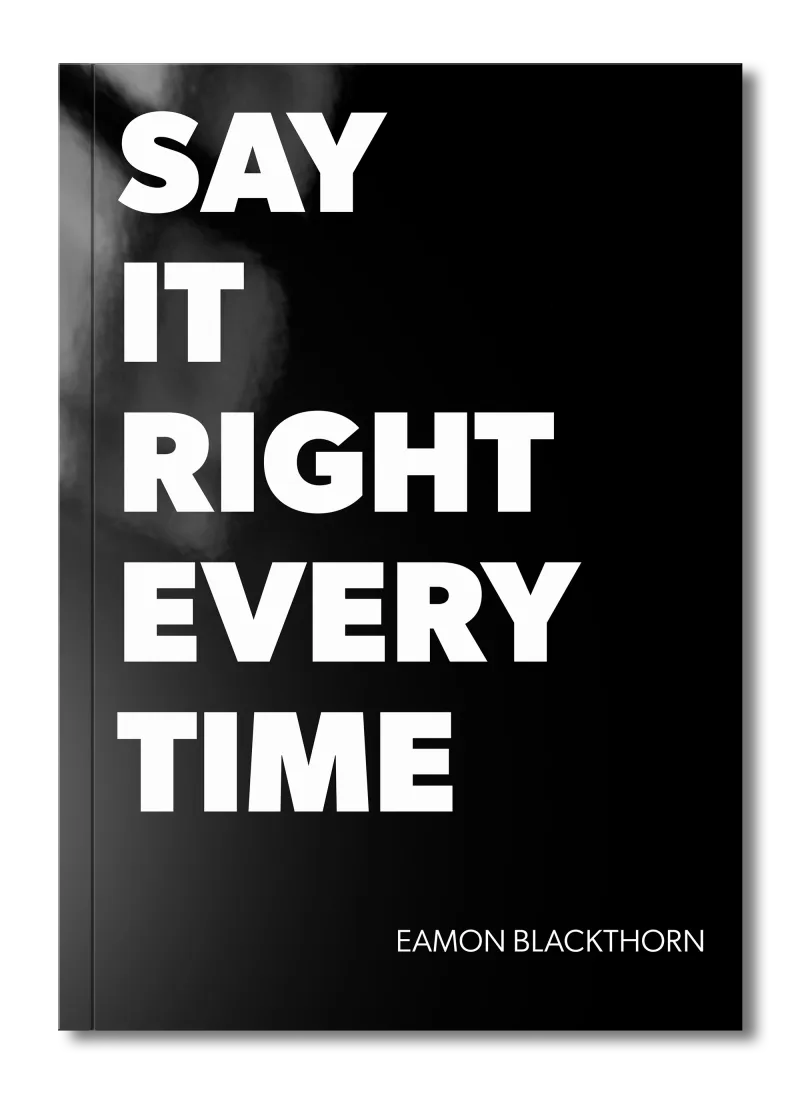
Stop rehearsing conversations you'll never have. Say It Right Every Time gives you 115 word-for-word scripts and 16 proven frameworks to speak with confidence in every conversation that matters.
What Needs to Be in Place Before You Begin
Patient hearing is not something you can improvise in the heat of the moment. There are two things you need to prepare before the conversation starts.
The first is a clear anchor to your own words. Know exactly what you intend to say before you say it. If you are vague going in, you will be unable to hold your ground when your words are distorted, because you will not be entirely sure what you said either. Write your key points down beforehand if the conversation is important. Read them once. This is not about scripting every sentence; it is about knowing your ground.
The second is emotional regulation. Not calmness, necessarily. You do not need to feel calm. You need to have a method for creating a pause between stimulus and response. A slow breath before speaking. Counting silently to three. Whatever works for you, practise it before you need it.
If you are already reactive before the conversation begins, no process will hold. Ground yourself first.
The Process: Six Steps for Staying Clear When Your Words Are Twisted
These steps work in sequence. Do not jump ahead. The early steps create the conditions the later ones depend on.
1. Hear the distortion without reacting to it.
When the twist happens, your first job is to notice it without responding to it immediately. Let the other person finish. Do not interrupt. Do not shake your head or make sounds of disagreement. Simply listen to the distorted version all the way through.
This is harder than it sounds. The urge to cut in mid-sentence is powerful. But interrupting confirms to the other person that you are defensive, and it prevents you from hearing exactly what version of your words they are now working from. You need that information.
2. Pause before you speak.
After they finish, do not respond immediately. Take a breath. Count three seconds internally. This pause serves two purposes: it slows your own nervous system down, and it signals to the other person that you are not simply reacting. A composed pause carries more authority than any words you could rush out in its place.
3. Repeat your original words precisely.
Here is the most important technical step in the entire process. Do not respond to the distorted version. Do not engage with what they said you meant. Anchor back to your exact original words.
The script is simple: "What I actually said was..." followed by your original statement, as close to verbatim as you can get. Not a paraphrase. Not a clarification. The original words.
For example, if you said "I think we should look at this before the deadline" and they responded with "So you're saying the whole team has been incompetent," you do not address the word incompetent at all. You say: "What I actually said was that I think we should look at this before the deadline. That was the full extent of what I meant."
This technique works because it removes the distorted version from the centre of the conversation and replaces it with your original statement. It is not aggressive. It is precise. Precision is a form of strength.
4. Ask one clarifying question, calmly.
After restating your words, ask a single question that invites the other person to explain the gap. Not a challenge. A genuine question.
Try: "I want to understand how you got from what I said to that conclusion. Can you walk me through it?"
This question does something useful. It puts the responsibility for explaining the distortion back on the person who created it, without accusation. It also keeps the conversation moving forward rather than stalling in a loop of "that's not what I said" versus "that's exactly what you said." Developing this kind of reflective approach connects directly to the broader habits of care around how to use 'I' statements in team conversations to prevent synergy-breaking blame cycles.
5. Listen to their answer with the same patience you applied in step one.
Whatever they say next, hear it fully. Do not assume the next thing they say will also be a distortion. Sometimes, when you slow a conversation down this deliberately, the other person recalibrates. They may walk the distortion back, or they may reveal the genuine concern underneath it.
If the genuine concern surfaces, address it directly. That is progress. If the distortion continues, repeat steps three and four. You can cycle through this sequence more than once. Each repetition costs them credibility and costs you nothing, so long as your tone stays level.
6. Name the pattern if it persists.
If the distortion continues across three or more exchanges, name what you are observing. Keep it neutral and specific.
Try: "I notice we keep arriving at a version of what I said that doesn't match what I said. I'd like to find a way past that."
This is not an accusation of bad faith. It is an observation about a pattern in the conversation. Done with a calm tone and without sarcasm, it often interrupts the cycle because it makes the distortion visible to both people at once. If you find you need to address these kinds of recurring conversational patterns in a team context, you may find it useful to read more about how to address passive-aggressive behavior that's silently eroding team synergy.
When the Conversation Is Happening Remotely
Remote conversations add a layer of difficulty to patient hearing that is worth naming directly.
On a video call, you lose the subtler non-verbal signals that tell you when someone is about to speak, when they are genuinely confused, or when they are deliberately distorting. The slight delay in audio can make your pause look like hesitation rather than composure. And the absence of physical presence makes it harder to hold the emotional ground that steady body language creates in a room.
A few adjustments help. Keep your camera at eye level and maintain steady eye contact with the lens rather than the screen. This reads as confidence, not passivity. Type your key points into a notes document before the call and keep it open beside the video window. If your words are twisted, you can read back your exact original statement without having to reconstruct it from memory under pressure.
Also, if a distortion occurs and the exchange is becoming circular, it is entirely appropriate to say: "I think this conversation would be clearer if we paused and came back to it when we have more time to give it." Remote calls can end or be paused in a way that face-to-face conversations cannot, and using that option is not weakness. It is good judgment.
For broader guidance on keeping remote team conversations from breaking down, the advice in how to deliver a neutral problem statement that stops team conflict before it destroys synergy applies across formats.
Where People Go Wrong When Trying This
Most people attempt some version of patient hearing and find it fails. Usually, one of three things has gone wrong.
The mistake: Correcting the distortion while still sounding angry.
Why it happens: The impulse to correct and the emotional reaction arrive together, and the correction carries the heat of the reaction.
What to do instead: Separate the two. Take the pause in step two seriously. Your words can be precise and calm even if your body is still tense.
The mistake: Engaging with the distorted version rather than the original words.
Why it happens: The distorted version is the thing being argued, so it pulls your attention.
What to do instead: Refuse to engage with it at all. Not dismissively, just pointedly. Your original words are the only thing you are accountable for.
The mistake: Asking multiple clarifying questions at once.
Why it happens: There are often several things to clarify, and the urge is to address them all.
What to do instead: One question at a time. Multiple questions sound like interrogation, which feeds defensiveness and produces more distortion, not less. For more on how feedback delivered poorly escalates rather than resolves, it is worth reading how to give constructive feedback without causing tension.
Your Pre-Conversation Checklist for Patient Hearing
Before any conversation where distortion is possible, run through these five points.
- Write your two or three key points in your own words before the conversation begins. Keep the language simple and specific.
- Identify your pause method: the specific action you will take between hearing a distortion and responding to it.
- Commit to the rule of responding only to your original words, not to the distorted version.
- Decide in advance that you will ask only one clarifying question at a time, and prepare a neutral form of that question.
- Set a private threshold: if the pattern continues beyond three exchanges, you will name it calmly using a neutral observation.
This checklist is not about predicting every turn the conversation will take. It is about anchoring yourself to a clear process before the noise begins, so that when the distortion happens, your response is already prepared rather than improvised.
The SBI method is a related tool for giving feedback that is resistant to misrepresentation, because it grounds everything in observable behaviour rather than interpretation. You can explore that approach in how to use the S.B.I. method to give feedback that actually changes behavior.
When the Bigger Picture Is Feedback Itself
Sometimes the conversation where your words get twisted is not a standalone exchange. It is part of a pattern of difficult communication within a team, and patient hearing is one piece of a larger set of skills you are trying to build.
If that is the case for you, look at the habits that surround these moments: how feedback is given, how conflict is named, how tension is managed before it becomes distortion. The article on how to give feedback that strengthens team synergy instead of breaking it addresses several of the conditions that make word distortion more or less likely. So does common communication mistakes that quietly destroy team synergy, which covers the kinds of communication habits that create the environment for distortion to flourish.
The Ground Beneath Difficult Conversations
Here is the truth of it. Patient hearing is not a gift some people have and others do not. It is a skill built through deliberate preparation and repeated practice. It will feel unnatural at first. You will be mid-process and the old instinct to push back will surge, and sometimes you will follow it. That is not failure. That is learning.
What I know after sixty years of getting this wrong more times than I can count is that the person who stays clear when their words are twisted holds more power in that room than the person doing the twisting. Clarity is disarming. Precision is steadying. And the ability to practice patient hearing skills under pressure, to anchor yourself to what you actually said and refuse to be pulled away from it, is a form of strength that very few people develop, but any person can.
The ground holds. Your words hold. Stay with them.
Frequently Asked Questions (FAQ)
What are patient hearing skills?
Patient hearing skills are the ability to listen fully and without reacting when a conversation becomes distorted or hostile. They involve deliberate pausing, precise repetition of your original words, and asking clarifying questions to prevent misrepresentation from escalating into conflict.
How do you practice patient hearing with a difficult person?
You practice patient hearing by staying grounded before you speak, repeating your exact original words when they are twisted, and asking a calm clarifying question rather than defending yourself. The goal is to slow the conversation down and restore accuracy without triggering further distortion.
Why do people twist your words in conversation?
People distort what others say for several reasons: defensive listening, high emotional arousal, a habit of arguing positions rather than hearing content, or a deliberate attempt to destabilize you. Recognising the pattern early helps you apply patient hearing before the distortion compounds.
What is the difference between patient hearing and passive listening?
Patient hearing is an active, deliberate skill that requires precise attention, controlled responses, and strategic clarification. Passive listening is simply not interrupting. Patient hearing demands that you track what was actually said, notice when it is misrepresented, and respond with calm precision rather than silence or reaction.
Can patient hearing skills work in high-conflict conversations?
Yes, though the process slows down and each step requires more deliberate effort. In high-conflict exchanges, patient hearing means anchoring every response to your exact original words, keeping your tone neutral, and resisting the pull to match the other person's emotional level.
How do I stop getting defensive when someone twists my words?
The most direct path is to pause before responding and name your original statement precisely. Defensiveness surges when you feel your meaning is under attack. Anchoring your reply to your actual words, rather than responding to the distorted version, removes the fuel that defensiveness needs to take hold.